Search This Blog

Showing posts with label Evolution. Show all posts

Thursday, November 20, 2025

Colonizing the Universe at Sub-Light Speed

The Ultimate Relativistic Sacrifice

Assuming Faster-Than-Light (FTL) travel is physically impossible and cryogenic hibernation is unavailable; humanity's expansion into the cosmos may rely on the extreme physics of time dilation from Special Relativity aboard some sort of colony ark. While time dilation will allow the crew to complete a voyage within their lifetime, the journey is an irreversible commitment that gambles the future of a civilization on a target millions of light-years away.


The Andromeda Challenge and the Irreversible Loss

The Andromeda Galaxy (M31) is our nearest major intergalactic target at approximately 2.5 million light-years distant. For the crew to complete this voyage in a human lifetime (e.g., 40 years of proper time), the ship must maintain a sustained average velocity of roughly 99.99999999995 c.

  • The Sacrifice: The travelers are not simply leaving home. They are permanently severing their connection to the Milky Way. When they arrive, 2.5 million years of cosmic, stellar, and biological evolution will have occurred in their home galaxy. Their families, their culture, and every trace of the civilization that launched them will be reduced to ancient memories.
  • A Temporal Gap: The voyagers exist in a tiny bubble of compressed time from which they will step into a universe that is unrecognizable to the one they left. They will have to pay millions of years of separation for their mere decades of travel.

The Existential Gamble

The greatest human impact lies in the uncertainty of the destination. The colony ark, having made the ultimate sacrifice, arrives 2.5 million years later. The pioneers will dependent on finding a habitable world.

  • Arrival on a Dead World: There is no guarantee of success. Target systems that looked promising via telescopes 2.5 million years ago may have undergone catastrophic changes. Target stars may have died, planetary orbits destabilized or life-bearing worlds may have been sterilized by a nearby supernova. The crew may be forced to settle a barely viable moon or asteroid, dedicating their compressed lives to the construction of a fragile habitat.
  • The Psychological Toll: Imagine emerging from a forty-year journey to find that the sacrifice of millions of years was in vain. Settlement options leave them desperate and even face slow extinction. The mental fortitude required for the crew to proceed with establishing a colony under such bleak conditions will be very a demanding for human endeavor.

Cosmic Expansion and the Event Horizon

The navigational challenge of intergalactic travel is a matter of pure survival, where failure means being permanently stranded in the dark void between galaxies.

1. The Super-Deep Space Trap

The massive target distance requires the ark to compensate for both the target galaxy’s movement and the expansion of the universe (Hubble flow) over millions of years.

  • Aiming for the Past: The crew must not aim for where Andromeda is now, but where cosmological models predict it will be millions of years in the future.
  • Gravitational Anchor: The ship must execute an instantaneous deceleration precisely within the gravitational well of the destination galaxy. If the deceleration occurs even slightly too far out, the surrounding spacetime expansion could accelerate the ship away from the galaxy before its local gravity can pull it in, stranding the crew in the empty, super-deep intergalactic void.

2. Reaching the Cosmological Edge

The concept of colonizing galaxies near the cosmological event horizon (currently 16 billion light-years away) highlights the final limit. Galaxies beyond this horizon are already receding faster than light due to accelerating cosmic expansion and are literally unreachable today, even at 0.999… c.

  • The Temporal Trap: To reach a galaxy near the horizon, the launch must occur almost instantaneously on the cosmic scale. If humanity delays too long, cosmic expansion will push that galaxy irrevocably beyond our reach, forever confining future generations to our local galactic neighborhood.

The Enduring Drive: A Galactic Legacy

Despite the risks and the terrifying finality of the journey, the impetus for expansion remains. We have an innate and evolutionary imperative to survive and propagate.

  • Successive Generations: If a colony succeeds in Andromeda, its primary goal is not to thrive, but to replicate the mission. The next generation of settlers will build their own relativistic arks, pushing further into the Laniakea Supercluster, driven by the knowledge that their future depends on finding and securing more footholds in the cosmos.
  • A Galactic Civilization: Each new colony, whether on an Earth-like world or in a sealed dome on a cold moon, becomes a new seed of humanity, creating a truly scattered, time-dilated galactic civilization whose survival is secured not by technology alone, but by the extraordinary sacrifice and unyielding courage of the original voyagers.

The Unavoidable Horizon and the Next Step

Such a relativistic colony ark would be more than just a ship. It will be a declaration of humanity's unyielding commitment to existence that must be secured regardless to possible costs. This colonization model, constrained by the immutable laws of physics (the speed of light and the accelerating expansion of the universe) forces us to recognize a sobering truth. Our window for becoming a truly galactic civilization is finite and closing.

The greatest challenge is not merely building the next ark, but cultivating the societal will to invest in such a millennia-spanning gamble. Before the first interstellar journey can even begin, we must achieve a few critical milestones:

  • Establish a Self-Sufficient Solar System: We must first master the art of survival away from Earth. Settling the Outer Solar System, as previously discussed, is the required engineering training ground, guaranteeing that the seed of humanity does not perish with the inevitable death of the Sun.
  • Achieve Kardashev Type II Capability: The energy requirements for a sustained 0.999… c voyage is so vast that they demand harnessing the power output of an entire star. This requires a civilization with an unprecedented scale of infrastructure and coordination.
  • Embrace the Temporal Sacrifice: The success of the journey rests on the psychological endurance of the travelers and the emotional maturity of the home world to accept the irreversible loss.

The final question for our species is no longer "Can we reach the stars?" but "Are we worthy of them?" Our willingness to make the ultimate sacrifice and to gamble millions of years of our history for the chance of a single new beginning will define whether humanity remains a fragile, single-star species or evolves into an enduring, time-scattered intergalactic legacy. The time to prepare for this final, defining endeavor begins now, before the accelerating expansion of the cosmos locks our future out of reach forever.


What Do We Do Now?

The path forward is clear. We need to Master our local region in order to plan for the galactic expanse. We should relentlessly pursue advances in fusion power, closed-loop life support and extreme deep-space navigation. We can act knowing that every technological victory at the solar scale moves us one step closer to making the ultimate and irreversible jump to the stars.

Also see:

Monday, March 31, 2025

Monkeydactyl: Pterosaur to Human?

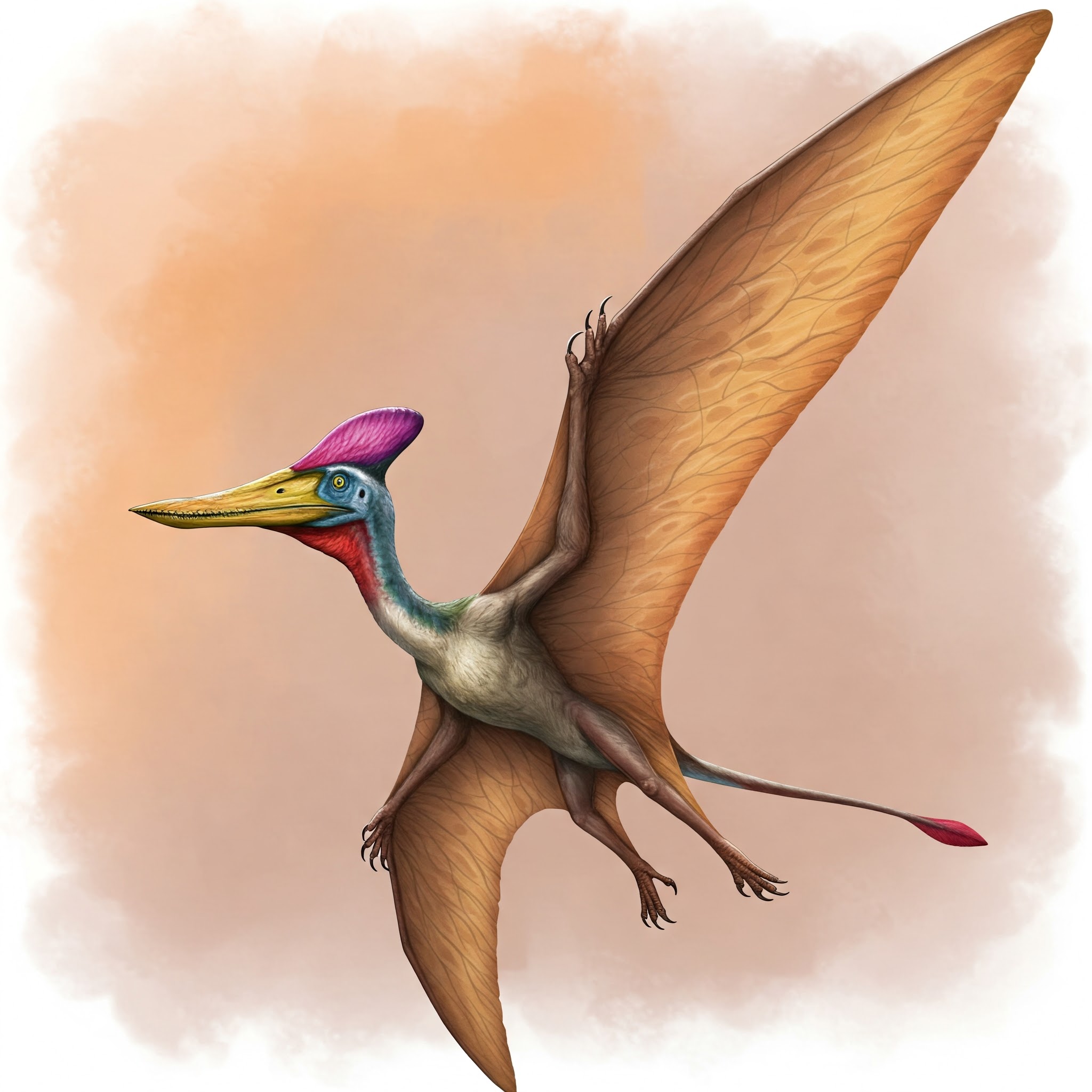
Imagine a world where pterosaurs didn't just soar, but swung through trees like monkeys. A recent discovery in China suggests this might not be pure fantasy. A few years ago, paleontologists unearthed a remarkable pterosaur fossil: a creature with opposable thumbs.  This species, Kunpengopterus antipollicatus (nicknamed 'Monkeydactyl'), lived roughly 160 million years ago and represents a pivotal moment in pterosaur evolution.  It's important to clarify that while often mistaken for dinosaurs, pterosaurs were a distinct group of flying reptiles, closely related to, but separate from, the dinosaurs. 

Though Monkeydactyl retained a classic pterodactyl-like body, its unique thumb structure hints at a potential shift towards arboreal life, perhaps even capable of navigating the forest canopy and soar above it.

Kunpengopterus antipollicatus

The discovery of Kunpengopterus antipollicatus establishes it as the earliest known reptile, and indeed one of the earliest animals, to possess opposable thumbs. This unique adaptation, coupled with the fossil site's rich assemblage of 150 other arboreal species, strongly suggests that Monkeydactyl thrived in a densely forested environment.  It's fascinating to consider that this ancient habitat shares similarities with those inhabited by early Homo sapien ancestors.  

Given this context, it's not entirely unreasonable to speculate that descendants of Monkeydactyl might have undergone convergent evolution, developing traits analogous to modern monkeys and apes.  Some lineages could have become increasingly specialized for arboreal life, exhibiting monkey-like features. While other branches might have evolved distinct adaptations, perhaps even resembling the mythical griffin, if we allow our imagination to roam.  In such scenarios, the selective pressures of a forest environment could have led to the gradual reduction or even complete loss of wings in certain pterosaur lines.

Aptepterus liaoningensis Nemogryphus scandens

Assuming the monkey-like lineage thrived, it's plausible that subsequent generations would have experienced further evolutionary shifts, trending towards ape-like characteristics.  Imagine a creature with even more robust and muscular arms were perfectly adapted for swinging and manipulating objects within the dense forest canopy.  This evolutionary trajectory would have favored enhanced dexterity, intelligence, and social complexity, mirroring the path taken by our own primate ancestors.
Primaptepterus simius

Imagine, if the ancient forests had shifted and opened into vast grasslands, much like the cradle of humanity in Africa. What if a flying creature became a climber? What if it then stood tall, abandoning the trees? What if, instead of wings, it held tools with hands to shape its world? 

A different path, a different mind, born from the same relentless dance of life, yet utterly alien from our own experience. Perhaps, in some other twist of fate, the echo of our own story could have been a song sung by kin with elongated snouts and covered with pycnofibers. Evolution's canvas is far wider, wilder, and weirder with the slightest environmental change.
Gnathambulator pterectus

Let your imagination take flight. What other extraordinary forms might evolution have sculpted, given a different turn of the cosmic wheel?

Wednesday, May 19, 2021

Suburban bird of prey tries out a new hunting style - Hide-and-seek


This suburban predator is trying out a new hunting technique called Hide-and-seek!  However, the tasty bunnies that are hiding from him don't seem to want him seeking them.  This was recorded a couple of days ago in Colorado, of course.

Monday, July 10, 2017

We didn't evolve from apes?

I'm not going to touch on arguments pro and con regarding evolution or creationism in this article. This is simply a criticism of a particular ploy used when some engage in those arguments.  It's common to hear a proponent for evolution to say the following when in a discussion with a creationist:
Humans didn't evolve from apes.  We evolved from a common ancestor with apes.
But this statement is disingenuous. The truth is that we did evolve from an early ape species which diversified over time into five great apes species and sixteen ape species, namely Bonobos, Chimpanzees, Gorillas, Orangutans, Humans and various Gibbons.  Sure, it's true we didn't evolve from Chimpanzees, but we did evolve from an ape species from which all other modern ape species also evolved.

Ape skeletons

I guess the claim of not evolving from apes came out of the desire to side step or disrupt creationists' arguments driven by their misconceptions about evolution.  If a creationist says "evolution says we evolved from apes", then it's an easy comeback to say "no it doesn't, actually."  But, in truth, yes, evolution does indeed say we evolved from an ape species, and this is backed up by modern discoveries.  There's no need dance around this by splitting hairs on what is meant by the word "ape".
  • Is a wolf a canine?  Yes.  Is a fox a canine? Yes.  Did wolves and foxes evolve from a common canine species? Yes.  Then wolves and foxes evolved from canines.
This example is just to drive the point home.  Canines and apes (all mammals, reptiles and amphibians, actually) all evolved from common tetrapod ancestor species that first lived on land about 400 million years ago. Yes, we are all tetrapods that evolved from a common tetrapod ancestor species.  In the larger scope, we evolved from tetrapods!  Just as more immediately, we evolved from apes.

Monday, June 17, 2013

Notion of Creation is not a theory, and scientific theories aren't proposed notions

Bible based knowledge does not lead to new scientific knowledge.  People used to think the Bible was useful to learn about nature.  They did try to use it as a guide to make new discoveries.  However, over time, scientists started finding out that the Bible just gets so much wrong.    The Bible literally has almost every major point wrong about the universe, from its description of Earth as a flat world with a tent over head to its description of rabbits as cud chewers. The value of the Bible is it's a general moral guide taken in the context within the times each portion was originally written/re-written. Taking it for more than that is truly grasping as straws.  People discovered the hard way that the Bible was not a good starting point to learn about nature. That's why the practice of referring to the Bible as a source for science was stopped over time.
So, to that point, Creationism based on the Bible isn't a theory. It is a failed notion. A theory isn't just a proposal. It is a proven working model of the Universe with a lot of peer reviewed data, from which accurate predictions can be made. To extend this further, those predictions often create new areas of exploration and further growth of knowledge, directly leading to new technologies, either in the exploration of the theory or as a result of knowledge learned from the theory. Last major invention spurred by Bible belief was the telescope, and use of that technology disproved that belief; the creator being forced to recant his statements about reality and live under house arrest for the remainder of his life.

On the other hand, Darwin didn't create the Theory of Evolution, he proposed the core concepts based on his observations. Evolution was born out of the peer review process with much more independently collected data. Evolution wasn't a theory until there was a massive amount of data and extraneous amount of analysis of that data, from which the natural model was molded.

Why is Creationism not a theory? Because it doesn't have one iota of this. The supporters want a magical shortcut, using circular arguments and cherrypicked research of other people's works in the form of anecdotes and impressive looking fake equations. No actual proven predictions come from Creationsm nor from its child contrivance called Intelligent Design. Creationism is the end of knowledge, not its birth. That is why is it not a theory and it is not science. Now, that said, the challenge is always there for Creationism supporters to objectively collect data and test hypotheses. Even if they don't prove their hypotheses, at least new knowledge would come from that. This process has yet to be undertaken by Creationist (and Intelligent Design believers), or if it has, results have been hidden.

Examples of observations that would grow knowledge along the Creationist track:
  • Find DNA in mammals that cannot be traced back to a common ancestor or introduced by some other natural process.
  • Show completely distinct lifeforms with no ancestry at all. 
  • Find data that offers new evidence to reinterpret apparent evolution in our own species, from malaria resistance to lactose persistence.
  • Additionally, find data that better explains why pre-agricultural humans did not have cavities and modern humans with no cavities is almost unheard of? (Hint, that has been very well explained with a recent study of mouth-dwelling bacteria and their evolution to adapt to our changing diets, along with our own evolution for such too.)
These examples cannot be explained with anecdotes.  Hard evidence has to be presented from scientific studies using the Scientific Method.  Research doesn't count for this.  New evidence has be presented.  That evidence must be collected and peer reviewed.  Until that happens, Creation Notion can never be put on equal footing with any Scientific Theory, especially the Theory of Evolution.

Thursday, January 03, 2013

Cavity causing bacteria, your days are numbered!

Gotta love the 21st Century! Now we know how cavity causing bacteria evolved and we can use that information against them!


Friday, May 21, 2010

Bode's Law

Bode's Law, or Titus-Bode Law, is a now refuted law governing planet location with our Solar System. It presumes a relationship between all of the planets in their distances from the Sun.

Formulation

The Law relates the semi-major axis, a, of each planet outward from the sun in units such that the Earth's semi-major axis = 10, with

a = n + 4
where n = 0, 3, 6, 12, 24, 48 ..., with each value of n > 3 twice the previous value. The resulting values can be divided by 10 to convert them into astronomical units (AU), which would result in the expression

a = 0.4 + 0.3 · 2 m
for m = , 0, 1, 2,...[1]

For the outer planets, each planet is 'predicted' to be roughly twice as far away from the Sun as the next inner object.

Origin

It's name comes from the fact that it was promoted by Johann Elert Bode when in 1768, he wrote the second edition of his astronomical compendium Anleitung zur Kenntniss des gestirnten Himmels, which states the following.
Let the distance from the Sun to Saturn be taken as 100, then Mercury is separated by 4 such parts from the Sun. Venus is 4+3=7. The Earth 4+6=10. Mars 4+12=16. Now comes a gap in this so orderly progression. After Mars there follows a space of 4+24=28 parts, in which no planet has yet been seen. Can one believe that the Founder of the universe had left this space empty? Certainly not. From here we come to the distance of Jupiter by 4+48=52 parts, and finally to that of Saturn by 4+96=100 parts.

History

At the time, Saturn was the farthest known planet. Bode's Law gained credibility when Uranus and then Ceres where discovered. These bodies happened to fall in line with predictions made by the formula. However, this Law become refuted when Neptune was discovered at a location from the Sun that was no where near its predicted location.

Also, to further refute Bode's Law is the fact that other systems exist in our Solar System which do not follow its formula. Although the moons around Jupiter, Saturn and Uranus do follow some sort of pattern, they do not follow Bode's Law; nor do they share patterns with each other.

Status

The discovery of Pluto and more recently other Kuiper Belt objects have proven Bode's Law to be false. It appears that Bode's Law was a misguided attempt to explain an observation that did not have enough data. Given what is known now, it seems that perhaps there is some sort of rule that applies to naturally formed orbiting body systems, but there is no formula that can predict the arraignment of such. Perhaps Bode's Law can be useful in the future, not to predict planet placement in other extrasolar systems, but maybe to point us in the direction to understand planet formation and resonance. We can see there is some sort of resonance. We can also see that a particular resonance is not shared between different systems, and only applies in a limited fashion. It is not useful for anything else. Although it really cannot be called pseudo-science, since it was based on observation and did make some predictions that panned out, it is really not useful science today. Further complicating the issue is that the definition of planet has changed. Ceres and Pluto are no longer considered planets. This means that any use of Bode's Law in the context of what is now known can be called pseudo-science.


Planet Distances from the Sun (from Wikipedia.org)

Mercury factor: 0
Bode’s Law: 0.4, Actual: 0.39

Venus factor: 1
Bode’s Law: 0.7, Actual: 0.72

Earth factor: 2
Bode’s Law: 1.0, Actual: 1.0

Mars factor: 4
Bode’s Law: 1.6, Actual: 1.52

Ceres factor: 8
Bode’s Law: 2.8, Actual: 2.77

Jupiter factor: 16
Bode’s Law: 5.2, Actual: 5.2

Saturn factor: 32
Bode’s Law: 10, Actual: 9.54

Uranus factor: 64
Bode’s Law: 19.6, Actual: 19.2

Neptune factor: 128
Bode’s Law: 38.8, Actual: 30.06

Pluto factor: 256
Bode’s Law: 77.2, Actual: 39.44

Sunday, April 25, 2010

Are Aliens Really Alien?

A question I've asked myself is that what if the beings we call aliens (visitors from other planets) are really not aliens at all, but inhabitants of our own planet. There are several ways for this to be true. The idea of ultraterrestrials and metaterrestrials is not new. However, there , is one more possibility that seems just as likely from a particular perspective.

There is a possibility that we are being visited by beings from the future. This is based on two assumptions. First, the human species will continue to evolve throughout time. Second, time travel is a technology that we will eventually obtain. If these two assumptions are true, then the most likely source of "alien" encounters is actually future evolved human-descended visitors that come back in time to observe their primitive past. They would come back to study us or to see us out of curiosity.

This would be that two major class of visitations would occur: site-seeing and scientific, or tourists and scientists. Almost on a lark to describe this possibility, I coined the term Future Evolved Terrestrial Tourists and Scientists (FETTS).

This would mean that some beings either come back to observe ancients times much in the same way we visit the pyramids or other ancients sites. In fact, there are stories that every president of the U.S. in modern times has seen U.F.O.'s at some point in their life. President Carter himself is even on the record as being a person who has seen one.

This also means that some other beings comes back to experiment on their primitive ancestors, much in the same way that we modern humans experiment on great apes, including climps.

This explanation is actually more likely than others if time travel proves to be easier than space travel. According to current understanding of the Universe, there is no reason as to why time travel shouldn't be allowed; though General Relativity does demonstrate that faster-than-light travel impossible. With this fact, assuming visitations from beyond are real, it seems most likely that these visitations are from our own world.

Wednesday, November 11, 2009

Predictions of Evolution of Alien Life

Evolution of life on other worlds is seeming more likely as human knowledge of the Universe expands. David Zeigler has recently proposed eleven Evolution Predictions of what abilities or traits will evolve on other worlds, conditions allowing. The predictions are that some lifeforms will be the following:
  • Water dependent and carbon based.
  • Chemosynthetic (chemical based energy synthesis) or photosynthetic (light energy synthesis).
  • Heterotrophic and predators of heterotrophs (food chain of lifeforms).
  • Passively or actively mobile to seek out optimum conditions. As such, body plans will evolve something similar to what we would identify as a head, with arrays of sensory organs.
  • Sessile (non-mobile or anchored in place).
  • Powered flight (birds, some insects, bats, pterosaurs), or at least directed gliding (flying squirrel, flying fish).
  • Parasites, which on Earth account for over 65% of the total number of species.
  • Genes will be selfish, and natural selection will spawn adaption to the environment.
  • Will have senses, especially sight, sound, touch, heat detection, etc.
  • Motile, organisms will have natural attraction and repulsion to stimuli.
  • Large bodies of water will foster a wide variety of lifeforms, which may independently evolution similar adaptions.
The list seems a little incomplete and maybe not well organized. It is a good starting point in the discussion of what we can expect to find on other worlds. It can help us in knowing where to look, as well. Perhaps this list is formed from human prejudice. However, with only Earth as our example, this (at least for the time being) seems to be a fair set of predictions.

Source: Skeptic Vol. 14 No. 2, 2008 - Predicting Evolution


Related articles

Saturday, October 10, 2009

Possible types of Alien Lifeforms (Part 5: Blue Plants?)

It has been sited by physicists that while photosynthesis on Earth generally involves green plants, a variety of plants of alternative colors may also utilize photosynthesis. The other colors might be preferred in places that receive a different mix of solar radiation than that received on Earth.

Plants on Earth are green because they contain chlorophyll. The chlorophyll is green because it absorbs mainly blue and red light in order to produce food for the plant via photosynthesis, while reflecting the green light frequency.

Scientists at NASA point out that if the stars for other planets were in a different state than our sun and if the light frequency that reached the planets' surface was different, then the plants would have also evolved a different type of photosynthetic pigment (other than chlorophyll). This pigment would be dedicated towards the different light frequencies received by the planet. This would cause plants to appear a different color from green, such as red and yellow.

According to recent studies, no photosynthetic plants would be blue-colored. This is because blue light provides some of the highest photosynthetic yields in the light spectrum. It is important for blue light to be absorbed rather than reflected. This is based on the physical quality of different frequencies of light produced by known types of stars.

One terrestrial example of energy conversion based on something other than ordinary light involves radiotrophic fungi that convert high energy gamma rays into useful energy using the melanin. (In most organisms melanin is used to protect the organism against ultraviolet and solar radiation.) Even still, ordinarily fungi derive their energy from decomposing other biomass, rather than by converting radiation into energy for itself.

It could even be possible for photosynthesis to occur using infrared light. In such an environment, plants may actually appear black.

It is fascinating to image the variations of life that are possible, even if life is based on the same fundamentals as our own.

Reference: Wikipedia article; Wikinews article; NASA - NASA Predicts Non-Green Plants on Other Planets; Dadachova, E; Bryan RA, Huang X, Moadel T, Schweitzer AD, et al. (2007). "Ionizing Radiation Changes the Electronic Properties of Melanin and Enhances the Growth of Melanized Fungi". PLoS ONE 2 (5): e457. doi:10.1371/journal.pone.0000457; Candace Lombardi "NASA: Plants on other planets not green". CNET, April 11, 2007; Julie Steenhuysen "New hue: Plants on other planets may be yellow, red". Reuters, April 11, 2007; Ker Than "Colorful Worlds: Plants on Other Planets Might Not Be Green". Space.com, April 11, 2007; “The Color of Plants on Other Worlds” by Nancy K. Kiang, Scientific American April 2008

Response
reddit

Related articles

Saturday, October 03, 2009

Possible types of Alien Lifeforms (Part 4: Silicon Life)

A popular Sci-Fi topic is alternative forms of life. A common idea is that life could be based on silicon instead of carbon.

The idea is based on the fact that silicon has valence number of four. This means that silicon atoms can be arranged in rings and in long chains that may be useful to create structures upon which biological molecules could be built. However, there are many drawbacks that must be overcome for life to efficiently use silicon as its basis.

Silicon based lifeforms would not have organic molecules used within Terran life. DNA would not be the basis for such life. However, the silicon based molecules may not be stable without an added level of complexity because silicon has a larger atomic radius and mass than carbon. It also has more difficulty forming stable molecules, particularly where water is present.

Even still, it is a possibility. For some reason, many Sci-Fi depictions show silicon based life as being rocklike in appearance. I'm not sure where this idea comes from. It's a bit like assuming carbon based lifeforms look like a lump of coal. I have a feeling that if we do discover silicon based lifeforms, they may resemble us more than many expect.

Reference: Wikipedia article and “Are Aliens Among Us?” by Paul Davies, Scientific American December 2007

Related articles

Sunday, September 27, 2009

Possible types of Alien Lifeforms (Part 3: Arsenic Life)


What if the basic molecules of life where completely different? Life on Earth needs water, carbon, nitrogen, hydrogen, oxygen, and phosphorous. This last one is of particular interest.

Phosphorous is not particularly abundant on Earth. Yet Terran life needs the element. A similar element that could replace phosphorous is arsenic. Of course, arsenic is poisonous to us. This is because it is so similar to phosphorous. It may be possible that life could have evolved on other worlds to use arsenic instead of phosphorous. This is because arsenic can do everything that phosphorous does (in the way of structural bonding and energy storage). It could also be used to drive metabolism. On such a world, phosphorous would be the poison because it would interfere with those functions, much as arsenic interferes with the functions of phosphorous in life on Earth.

Is it possible for lifeforms to be poisonous to each other because of their basic chemistry? Would it be dangerous for arsenic based lifeforms and phosphorous-based lifeforms to simply touch each other or even to life in the same space?

References: “Are Aliens Among Us?” by Paul Davies, Scientific American December 2007

Related articles

Tuesday, September 01, 2009

Possible type of Alien Lifeforms (Part 2: Exotic Amino Acids)


For the most part, life on Earth uses the same set of nucleotides (amino acids) to form the basis of their DNA. In all, almost all known life uses 20 particular amino acids. These are often classified by their bases as A (adenine), C (cytosine), G (guanine) and T (thymine). These are the basic building blocks of DNA. They are also used to build proteins. Of course, from a certain point of view, DNA is just a really long protein.

How DNA uses these amino acids is described by Paul Davies in his article Are Aliens among Us? published in Scientific American, Dec 2007. He states, "The genetic code is based on triplets of nucleotides, with different triplets spelling out the names of different amino acids. The sequence of triples in a gene dictates the sequence of amino acids that must be strung together to build a particular protein."

Alien lifeforms may use exotic amino acids that are far different than the ones used by life on Earth. It is possible that the set of amino acids we use may not even appear on other worlds. Evidence by scientific study suggests that there are many other forms of amino acids that may be useful (or at least available) for other types of life. Evidence of exotic amino acids on other worlds has come from meteorites. Also, others have been synthesized in the lab.

Other lifeforms from other worlds may be completely different from us while still using the same basic DNA structure we use. A question remains, would life formed by exotic amino acids be all that much different than Terran life in appearance? Would the exotic amino acids lead life to evolve along completely different paths that we as yet have not conceived?

Reference: “Are Aliens Among Us?” by Paul Davies, Scientific American December 2007

Related articles

Saturday, August 29, 2009

What are the odds of Humanoids evolving again?

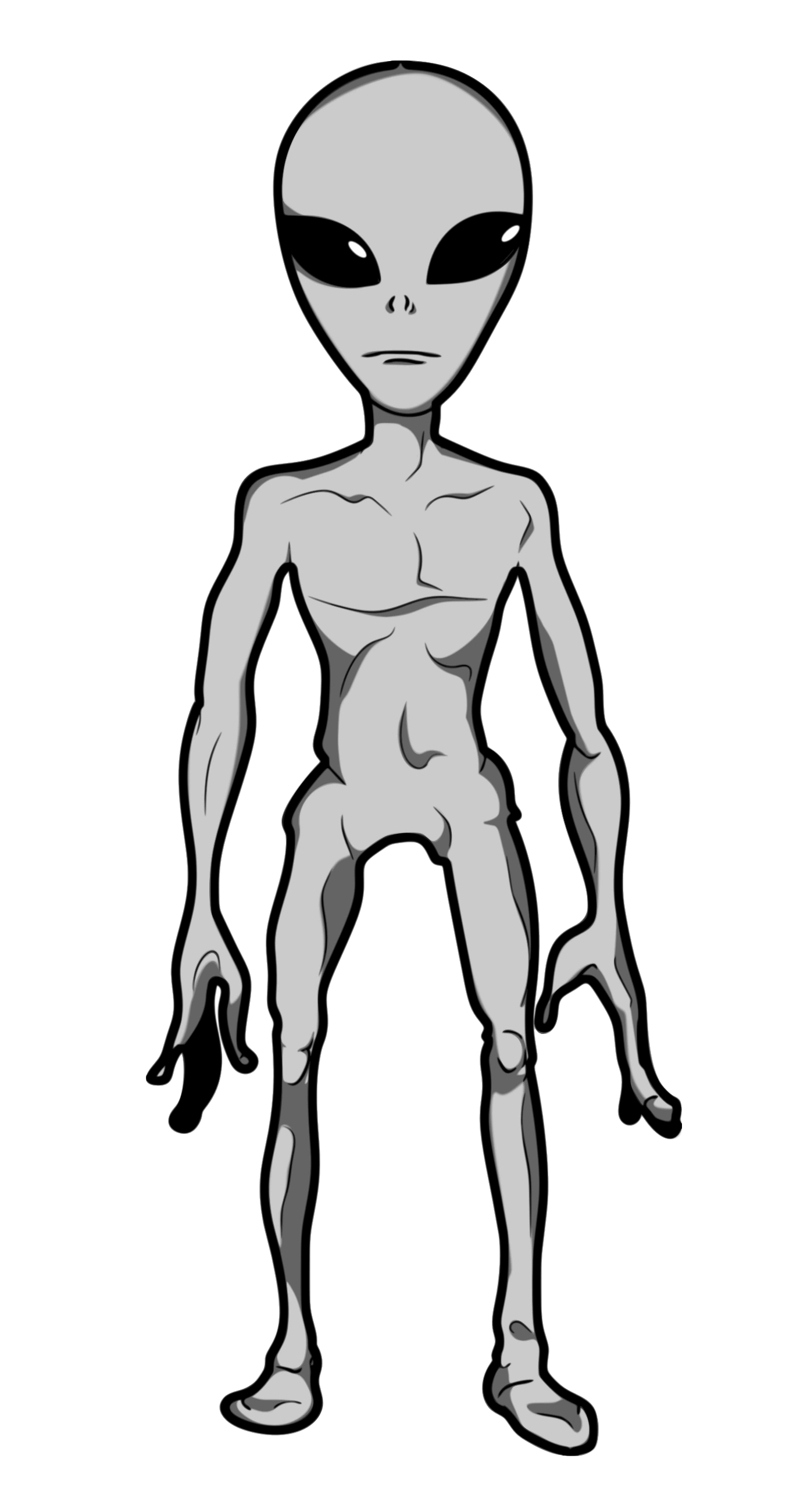
Humans take human-level intelligence for granted.  So much so, that our humanoid form seems to prevail any of our notions of intelligent life on other worlds.  Images of Greys, EBENs and other aliens have the same general plane symmetry body plan as us, with two arms, legs, a torso, a head, symmetric features, two eyes, mouth, nose holes, brain, etc.  But what are the chances of life evolving in this way again, either on another world or evolving again here on Earth after humans are gone?

The major problem with this is that life goes through a great number of changes as it evolves over time. At each point, a very specific set of criteria sets the stage for what is eventual deemed successful adaption and what comes to the end of the line. Given what little we know right now, it seems unlikely that changes at each step will follow the same path twice in different ecosystems and different worlds.

Sure, we do have convergent evolution, where multiple species evolve the same abilities in separate epochs and ecosystems.  But is human-level intelligence something that will happen naturally again?  Is having two legs, two arm, a face, etc, something that happens naturally as a matter functionality?  Could there be intelligence as advanced as ours, but in a completely different form?

We don't know anything concrete regarding evolution of life on the cosmic scale.   For years it was assumed that the form of our Solar System was common, and that is what makes life elsewhere likely.  We exist; there's nothing special about us; therefore life like us exists elsewhere.  This is a bit silly since we have no data to support that.   In fact, when we started finding planets in other star systems, the Solar System model proved to be quite unusual.

Maybe our understanding of evolution is still incomplete at the cosmic scale.  Maybe traits we see in Terran life are common on other worlds simply because these adaptions are the most successful in general, regardless of specific ecosystems that may exist.  Before people start declaring this or that is unlikely, let's collect data and find out.

Start sending probes to other star systems and poke about.  The probes will take a long time to get where they're going, but so what.   Unless we humans kill ourselves off (or nature does it for us), our posterity should be around to receive the results of our efforts, so that they can figure this out with actual evidence, instead of relying on unscientific guesses (see Drake's Equation).

Related articles

Possible types of Alien Lifeforms (Part 1: Mirror Life)


On Earth, life uses what is called right-handed DNA. Right-handed DNA uses left-handed amino acids, sometimes described as homochiral. The fact that all lifeforms on Earth use Right-handed DNA suggests that all life here is descendant from a common group of ancestors.

Why does the difference matter? If single cell members of mirror life (with left-handed DNA) are placed in a nutrient broth consisting of only left-handed amino acids, the lifeforms will not be able to thrive. The same is true of the reverse.

Mirror life is a type of lifeform that uses the same type of DNA structure, but where the DNA is left-handed. This type of life, in turn, used right-handed amino acids.

UFO Grade SchoolThe possibly that life on other worlds may be mirror life is very exciting. If found, it would lend tremendous evidence that life is possible in other forms as well.

----

Reference: "Are Aliens Among Us?" by Paul Davies, Scientific American December 2007

Related articles

Thursday, May 08, 2008

Something in the Air

I recently wrote an article about the platypus species being the most primitive of all mammals. Funny that only a couple months later there is now a news story about this vary same thing. The news story is originally from Livescience.com here. There is new interesting information about the fact that although the platypus has the X and Y chromosomes, these are not the sex chromosomes for the platypus. Instead, the platypus has about 10 other chromosomes for that purpose. Strange animal, this platypus

Sunday, March 23, 2008

Evolution of Mammal Traits

Sometimes I am just fascinated by how mammals became, well, mammals. It is wild to think that the incredible variety of mammals we see today, from the smallest mouse to the biggest whale, all came from just a handful of ancient species. And a lot of what makes us mammals is not what people typically image.

Take our hearing, for instance. Most people do not realize its unique composition. We have three tiny bones in our inner ear, the malleus, incus, and stapes, that work together to give us our amazing hearing. The first two actually evolved from bones that other animals use for their jaws! This is a huge difference from most other animals. And, of course, there is the one thing everyone knows: we feed our young milk. This is such a complex process that it is no wonder some people find it easier to believe we were just "made" this way. But the evidence for evolution is out there, and it is not all in the fossil record.

A Living Look at Evolution

The platypus is probably the most primitive mammal alive today, and it shows us a lot. It still lays eggs, a very reptilian trait. But, it also feeds its young a kind of milk, though not from nipples. Instead, it secretes a milk-like substance from a hairy patch on its belly. This secretion does not just feed the babies; it also has antibacterial properties that might help protect the egg and the young after they hatch.

From there, we can look at the echidna. This little guy represents a step toward marsupials. It lays eggs too, but it places them into a pouch on its body. This must be what a primitive marsupial looked like before egg-laying was replaced with embryo birth.

Marsupials have their own unique advantages. Because their young leave the womb so early, there are fewer complications from the mother's immune system attacking the embryo.

But then you have us, placental mammals. The placenta is a complete game-changer. It allows the fetus to develop for much longer and in a more protected environment inside the mother. The fact that placental mammals are now the most dominant form of mammals shows this is an advantageous trait.

Even with all our advanced development, mammals have not been around for very long. We have far fewer varieties of species than reptiles, for example. Given how far we have come, I am excited to see what future classes of animals will evolve on our planet.

Monday, December 10, 2007

Fruitcake for Xmas

According to a recent Reuters report, a Christian biologist is suing Woods Hole Oceanographic Institution for firing him because he believes against evolution (claiming civil liberties violation). This Christian "biologist" is now working for Rev. Jerry Falwell's Liberty University. This strikes me as a bit convenient. This guy gets a job at a respected institute and then reveals he believes against scientific fact after he's hired, and is now working at a religious institution? Hmm, sounds like a set up to me. I wouldn't be surprized if he applied at all the major places hoping to catch a big fish to bring this issue up (knowing that Liberty University or something similar would be available for him to fall back on). He prolly was already conspiring with his religious buddies before he even went to college to get his degree in biology.
Sorry to disappoint, a person who believes against scientific fact does not get protection under the Constitution and modern Civil Liberties as a protected class when it comes to a job that needs acknowledgement of scientific fact in order to perform required tasks, nor is someone that conspires against reality. A person can be fired for what they choose to say Not to mention the fact that believing against scientific fact precluded him from being able to perform his job at a scientific institution!
In good conscience, I don't know how he could call himself a biologist. I would go so far as to note that his biologist degree doesn't have validity if he decries the basis upon which it was based. If he really does believe against scientific fact, he should return his degree to the institution which issued it to him and obtain a new degree in Religious Studies or something.

Monday, April 23, 2007

Superstitious metaphor

I am superstition only to the extent that I know thinking about something contributes to making it real to me. The new goal I set for myself is to focus on what I desire, and discontinue thoughts on that which I spurn. I feel this simple truth is nothing new, however. It was expressed by the ancients through metaphor, in the form of stories about gods. In that, I do not hold any beliefs regarding gods. When I do refer to god, it is simply the knowing use of such as a metaphor. Another metaphoric use of gods employed by the ancients was to plainly explain and understand what was then unknowable. As knowledge increases, that metaphor loses value.

However, this does not mean I deny the spiritual or supernatural experience. Too many people from every realm on Earth, in every known time frame, and walk of life have extraordinary experiences that go beyond simple physical world explanation. Too easy is it when someone who is void of such experiences attributes anecdotal recountings to the devil or imagination. I regard these dismissals as silly.

Even after experiencing something extraordinary, it is hard for some to understand the experience properly because they have been so indoctrinated with a system of beliefs. How much less so can someone who has not experienced a thing judge one who has?

The question is why have beliefs? Why not base everything on the self-quest for knowledge? I find that I seek out what others have learned, and augment that with my own experiences. For example, I know that terrestrial life develops over time through the processes of evolution and natural selection, but I do not hold a belief about these. I simply know that discernable and testable evidence makes knowledge about these processes more clear. I don’t try to fit in a god into my understanding of these processes. Nor do I try to use my limited knowledge of these processes to come up with unsupported conclusions that I then rigidly believe. In other words, I do not hold any beliefs about how life got started, even though I have knowledge about how it develops. I am aware of notions and ideas about the origin of life, but I treat these has just that. I do not need to have a belief regarding the origin of life in order to know that evolution is currently the best description of those processes.

My experience is that Christians and Atheists alike are too easy to judge something based on beliefs they hold, rather than on the human experience itself. To a supernatural event, the Christian will say, “It was God’s will” or “The devil did that”. To that same event, the Atheist will say, “It was your imagination” or “You misinterpreted the event; there must be a logical explanation.” To this I say that’s pretty arrogant to assume that they know the answer outright. In particular, this is the one area with Atheist are hypocrites because the general idea behind atheism is the lack of beliefs without evidence. If they have no evidence one way or another, they normally don’t jump to conclusions, except when something supernatural or spiritual is being questioned. Of course, Christians just make stuff up in their heads as they go along, in order to fit everything into their picture of this world created from their overly literal, under-educated understanding of ancient texts.

It’s expected to develop notions about something, and to test those as hypothesis. Most of us are in the wrong profession and/or will simply not live long enough to have the time to challenge every hypothesis or theory for ourselves. So, some bit of trust has to be placed in the works of others. Just as long as everything is understood as not absolute, it’s ok to accept reasonable margins of error in one’s knowledge.

I am not an atheist. I am not religious either. To me, both are contrary to my experiences and gathered knowledge. Both have had value in the process of developing my current knowledge base. They are not useless. They are both stepping stones to gaining experience and knowledge in one’s life. They both have their place, though neither can be used as reason to end the search for new knowledge and experiences.

Focusing one’s thoughts on a god can make that god real to that person. But each of us has the power to create our own metaphoric god. Judging someone’s metaphor is ultimately a judgment of our own. In this, I am also a little superstitious. Do not judge, lest ye be judged. Of course, I’m not perfect. I judge all the time. It’s the effort that counts; at least in my metaphor.