Search This Blog

Showing posts with label Observation. Show all posts

Thursday, February 12, 2026

Will the Gaming Industry Change Use of FPS and TPS?

The Inertia of Familiar Language 

The traditional definitions of first- and third-person games rely on camera placement rather than on player agency. That shortcut has distorted how we talk about perspective for decades.

So why has this never been corrected?  The short answer is likely inertia.

Once a term becomes familiar, widely taught, and commercially useful, it stops being descriptive and starts being infrastructural. Changing it becomes expensive, not just financially, but culturally.


The FPS Effect

The modern taxonomy of game perspective crystallized in the 1990s with the rise of the first-person shooter (FPS).

“FPS” was an unusually successful label:

  • It described what players saw

  • It differentiated a new genre

  • It was easy to market

  • It spread quickly through magazines, retail shelves, and early web discourse

Once first person became synonymous with “camera at eye level,” everything else was forced into contrast. The term third person did not emerge from narrative theory. It emerged as whatever FPS was not.

This asymmetry locked the vocabulary in place before anyone had reason to question it.


Camera Language Is Easier Than Agency Language

Camera placement is concrete. Agency is abstract.

It is far easier to say:

The camera is behind the character

than to say:

The player issues commands to a represented self

Marketing departments, tutorial writers, and reviewers naturally gravitated toward the simpler explanation. Over time, that simplification hardened into definition.

Once perspective was taught as a visual property, revisiting it as a player–system relationship required more effort than most discourse was willing to invest.


How Designers Commonly Talk About Perspective

In public-facing discourse, perspective is usually described in terms of camera placement. In design-facing discussions, however, the vocabulary often shifts.

Designers frequently frame perspective through concepts such as:

  • Player embodiment

  • Identification with an avatar

  • Degrees of abstraction

  • Command versus inhabitation

  • Latency between decision and action

These ideas appear regularly in design talks, postmortems, and critical writing, even when the traditional labels of first- or third-person remain in place. The emphasis is less on where the camera sits and more on how the player relates to what they control.

This does not mean designers uniformly reject camera-based terminology. Rather, it suggests a practical distinction: the internal language of design often exceeds the precision of the public labels used to describe games.

In other words, the mislabeling persists not because designers lack conceptual tools, but because those tools are rarely surfaced in player-facing taxonomy.


Why the Industry Is Unlikely to Fix the Labels

Even if the argument is sound, several forces resist change:

1. Legacy Vocabulary

Decades of books, articles, reviews, and tutorials use the existing terms. Revising them would create friction with historical material.

2. Search and Discovery

“Third-person action game” is a deeply indexed phrase. Replacing it would damage discoverability without offering immediate commercial upside.

3. Audience Expectations

Players already believe they know what these terms mean. Correcting them risks sounding pedantic or confusing, even when accurate.

4. Mixed Perspectives

Many modern games blur categories intentionally. Studios may prefer flexible ambiguity to precise taxonomy.

Taken together, these pressures make formal correction unlikely.


Why This Still Matters

If the industry is not going to change its labels, why insist on the distinction at all?

Because language shapes analysis.

Mislabeling perspective:

  • Obscures why certain games feel immersive despite external cameras

  • Confuses discussions of agency and control

  • Flattens meaningful differences between avatar play and command play

  • Makes serious criticism sound mystical rather than structural

A player-centric model gives critics, designers, and players a sharper vocabulary—even if public-facing labels remain unchanged.


The Value of a Parallel Vocabulary

This series is not a call to rename genres overnight. It is a proposal for a parallel framework that can coexist with existing terminology while offering greater precision.

Just as film studies distinguish between camera angle and narrative voice, game analysis benefits from separating:

  • What does the camera do

  • What is the player

Keeping these concepts distinct allows deeper discussion without breaking compatibility with established language.


A Useful Mental Reframe

Rather than asking:

Is this game first person or third person?

Ask:

Who is acting?

Who is being addressed?

Where does the player exist in relation to the system?

These questions remain valid regardless of genre, technology, or trend.


Keeping It Going

The industry is unlikely to abandon camera-based labels. They are too entrenched, too useful, and too familiar.  But clarity does not require replacement. It requires recognition.

We can say that a game has first-person perspective with third-person camera angle. Or, a game is second-person perspective with the ability to show either game-piece camera angle or top-down third person camera angle.  Such descriptions are more meaningful. 

Once we understand that most so-called third-person games are structurally second-person, a great deal of confusion dissolves. Design intent becomes clearer. Player experience becomes easier to articulate.


Also see

Sunday, February 08, 2026

Real-World Games and Player Perspective

Why Physical Games Clarify the Debate

If digital games complicate questions of perspective with cameras, avatars, and simulated worlds, real‑world games strip those ambiguities away. There is no virtual camera, no rendering engine, and no ambiguity about where the player exists in relation to play.

What remains is the core relationship that person actually describes: how the player is positioned relative to action and agency.

When we apply the same player‑centric framework to physical and tabletop games, the mislabeling of digital perspectives becomes immediately obvious. The categories align cleanly without edge cases, caveats or special pleading.


First Person: Embodied Physical Play

In first‑person games, the player is the acting body. There is no representational layer.

Examples 

  • Tag

  • Soccer, basketball, martial arts

  • Darts, bowling

  • Poker (as bodily participation rather than avatar play)

Perspective Structure

  • The player acts directly

  • The player’s body is the locus of agency

  • There is no token, piece, or proxy

The language of play is unambiguously first person:

I run.

I throw.

I bluff.

No one meaningfully describes these games as issuing commands to a representation. There is no interpretive distance between decision and action.

This is first‑person perspective in its purest form, mapping precisely onto digital first‑person games where avatar and player identity collapse into one.


Second Person: Token‑Mediated Play

Second‑person play emerges the moment a personal proxy is introduced.

Examples

  • Monopoly

  • The Game of Life

  • Sorry!

  • Most role‑playing board games

Perspective Structure

  • The player is personally represented

  • Actions are issued to a token

  • The token is “you,” but not identical to you

The language shifts naturally:

You move three spaces.

You pass Go.

You go to jail.

No one confuses the plastic token with the player’s physical body. No one treats the token as an unrelated entity either. It is unmistakably you, addressed directly.

This is the exact structural relationship found in traditionally labeled “third‑person” digital games:

  • A visible body

  • A controllable character

  • A personal avatar that can be observed, directed, and positioned

The tabletop world exposes the truth that digital cameras obscure: this is second‑person play.


Third Person: Unembodied Command

True third‑person perspective appears when the player has no personal representation at all.

Examples

  • Chess

  • Checkers

  • Go

  • Wargames with multiple units per side

Perspective Structure

  • No piece represents the player

  • All entities are equally external

  • The player exists entirely outside the system

The language reflects this detachment:

That piece captured the queen.

These troops were sacrificed units.

That side is losing control of the board.

Even when players identify emotionally with a side or strategy, no single piece is you. The relationship is observational and managerial rather than embodied.

This maps cleanly onto digital strategy games, god games, and simulation titles where the player’s presence is abstract, systemic, or omniscient.


Why These Categories Feel Obvious Offline

In physical games, no one argues that Monopoly is “third person” or that chess is “first person.” The distinctions feel intuitive because:

  • There is no camera to confuse viewpoint with identity

  • Tokens and the actually human self are physically distinct

  • Agency is visibly mediated or not

Digital games inherited linguistic categories before these distinctions were fully examined. Real‑world games demonstrate that the confusion is not conceptual, but rather it is terminological.


The Consistency Test

A useful diagnostic question emerges:

If this game were played on a table instead of a screen, what would represent the player?

  • Your body → First person

  • Your personal token → Second person

  • Nothing at all → Third person

This test holds across media, genres, and technologies.


Implications for Game Analysis

Understanding perspective through real‑world analogs helps clarify:

  • Why some games feel intimate despite external cameras

  • Why avatar visibility changes player psychology

  • Why command‑based games encourage strategic rather than empathetic thinking

  • Why VR intensifies embodiment without redefining perspective

Most importantly, it reinforces the fact that perspective is about player–action relationships, not visual framing.


Looking beyond

Real‑world games quietly and intuitively preserve the original linguistic meaning of person in the terms of first-, second- and third-person. When we let them inform our understanding of digital play, the long‑standing mislabeling of game perspectives becomes impossible to ignore. The camera never determined perspective; the player's relationship within the game makes that determination.


Also see:

Friday, February 06, 2026

A Player-Centric Model of Game Perspective

From Definitions to Application

The previous article in this series established a narrow but important claim: camera angle does not determine narrative person. "Person" in "first-person" describes who acts, not where the camera viewpoint is placed.

Taking this into consideration, let's apply the concept directly to video games. Doing so requires shifting perspective from what the player sees to how the player is represented within the game system.

This article proposes a player-centric model of perspective and uses it to reëxamine the three categories commonly described as first-person, second-person and third-person.


A Player-Centric Definition of Perspective

Rather than anchoring perspective to the camera, this model defines person by the relationship between the player and the acting entity in the game world.

Person Defining Question Player Relationship
First       Am I the body acting? Player and avatar are the same entity
Second Am I directing a represented “you”? Player controls a personal avatar
Third Am I commanding others? Player is unrepresented in the world

This framework does not replace existing camera terminology. It runs alongside it. A game can still be described as having a first-person perspective with a third-person camera. What changes is how we describe player perspective.


First-Person Games: “I Move Here”

In first-person games, the player and the avatar collapse into a single acting subject. There is no meaningful distinction between the decision-maker and the body that carries out those decisions.

Common examples include:

  • Doom

  • Counter-Strike

  • Mirror’s Edge

  • Most virtual reality titles

Player intent is expressed directly as action:

I reload.

I lean around the corner.

I jump.

The defining feature is not the absence of a visible character model. It is the absence of narrative distance. The player does not instruct a character. The player acts.


The Misnamed Middle: Games Labeled “Third-Person”

Most action and role-playing games are grouped under the label of third-person:

  • Tomb Raider

  • The Witcher

  • God of War

  • PUBG

This category is where the traditional terminology begins to fail.

In these games, the player does not fully inhabit the avatar in the way first-person play requires. The character on screen is visible, persistent, and separate. The player does not experience the world as the body. The player directs the body.

The internal language of play reflects this relationship clearly:

You roll.

You climb.

You draw your weapon.

This is not metaphorical. It is structurally second person. The avatar represents the player, but the representation is mediated. The player and the character are not the same acting subject.

What distinguishes this middle category is not camera distance, character visibility, or animation style. It is addressability. The player addresses a personal avatar that exists as an object in the game world.

That distinction matters. A player can empathize with, customize, and narratively identify with an avatar while still relating to it as "you" rather than "I." The presence of dialogue choices, equipment management, and movement commands reinforces this relationship. The player tells the character what to do. The character then does it.

The camera makes this separation obvious, but it does not create it. Even if the camera were forced to overlap the character’s head, the underlying relationship would remain unchanged as long as the player continues to issue instructions to a represented self.

The moment a player can observe their own body as something acted upon, perspective has already shifted away from first person.

This is the core of the mislabeling. These games are neither first-person nor third-person in the narrative sense. They occupy a distinct middle ground that aligns cleanly with second-person structure.


True Third-Person Games: “They Move There”

Third-person perspective, in the narrative sense, emerges when the player is not embodied at all.

Strategy and command-based games provide clear examples:

  • Civilization

  • X-COM

  • Command & Conquer

  • StarCraft

Here, the player does not control a personal avatar. Instead, they direct multiple agents, units, or factions.

The language of play naturally changes:

They advance the unit.

They lose morale.

They capture the city.

Even when the game provides a narrative role such as ruler, commander, or overseer, that role is abstract. No single entity in the game world stands in for the player.

This aligns cleanly with third-person narration in literature. The player observes and directs, but does not inhabit.


A Shift in Perspective

Reframing game perspective around player representation reveals a gap in the familiar terminology. What has long been labeled third-person gameplay occupies a distinct middle ground that matches second-person structure far more closely than third.

This does not mean existing labels must be discarded. It does mean they should be understood as describing cameras rather than perspective.

The next article in this series steps away from digital games entirely. By examining board games and other real-world play, it becomes easier to see why camera-based definitions were always an awkward fit.

Continue to Part III: Real-World Games and Player Perspective. 

Saturday, January 31, 2026

We’ve Been Using “Third-Person” Wrong for 30 Years in Gaming

A Comfortable Mistake

Video games are routinely sorted into neat perspective boxes: first-person and third-person. The terms feel intuitive, established, and beyond dispute. An FPS shows what the character sees. A third-person game shows the character from the outside. A second-person game doesn't truly exist, per se. Case closed. 

Except that this framing quietly borrows language from literature and then uses it incorrectly.

In grammar and narrative theory, person is not about camera placement. It is about who is the acting subject. Once we apply that definition consistently, a strange realization emerges: what the games industry has long called third-person does not actually describe a third-person relationship at all.

This article is the first in a short series. Its purpose is not to reclassify games yet, but to clear conceptual ground. Before we can argue about first, second, or third person in games, we need to be precise about what those terms mean.


Camera Angle Is Not Narrative Person

Before redefining perspective, one clarification is essential: camera angle does not establish narrative person.

Games inherited the terms first-person and third-person largely through visual analogy. The distinction became shorthand for what the player sees on screen, not for how the player is positioned within the system of action. This shortcut made the terminology easy to teach, but conceptually unstable.

In literature and narrative theory, a scene can be described from any imaginable vantage point without changing grammatical person. A third-person novel may describe events from directly behind a character’s eyes. A second-person text may position the reader outside their body. A first-person account may briefly describe the narrator from an external viewpoint for dramatic effect.

The camera, or its literary equivalent, does not determine personhood.

By tying person to camera placement, game discourse quietly collapsed two distinct ideas:

  • Cinematography: where the viewpoint is located

  • Narrative person: who the acting subject is

Untangling these concepts is the key to understanding why the familiar labels begin to break down under closer inspection.


What “Person” Actually Means

In language and literature, person refers to the relationship between the speaker and the subject of action:

  • First person: I act ("I walk down the road")

  • Second person: You act ("You open the door")

  • Third person: They act ("She draws her sword")

Person describes agency and identity, not point of observation. It answers a simple question: who is doing the acting?

This definition has remained stable across centuries of grammar, rhetoric, and narrative theory. What changes from medium to medium is not the meaning of person, but the techniques used to express it.

Game terminology drifted away from this definition by anchoring person to the camera rather than to player representation. Once that shift occurred, the labels continued to function socially even as they lost their original precision.


Clearing the Ground

At this stage, no games need to be reclassified. The only claim established here is a foundational one: camera placement and narrative person are not the same thing.

If person is understood as a question of who acts rather than where the camera sits, the familiar categories of game perspective become less stable and more interesting. Some labels begin to feel strained. Other labels begin to feel incomplete.

The next article in this series builds on this groundwork by proposing a player-centric definition of perspective and applying it directly to video games.

Continue to Part II: A Player-Centric Model of Game Perspective.

Tuesday, October 21, 2025

Old Fashioneds are always different everywhere

Old Fashioneds are always a bit different everywhere. I didn't used to try them, but now it's become a point of study to try one at interesting places, like Speakeasies.

Instagram: https://www.instagram.com/p/DOXKxctjPgz/?hl=en

Tuesday, December 10, 2024

Watching movies where an accomplished writer is typing their book by pecking at their keyboard with their index fingers

Ever noticed the typing scenes in movies? Almost every film has this issue: when a character is shown typing—be it on a keyboard or a typewriter—they're pecking away like a chicken with their index fingers. This is especially absurd when the character is supposed to be an accomplished writer. Instead of touch-typing, they're either mashing keys aimlessly or stabbing at the keyboard as if playing a piano concerto.

It’s as though no actor on the planet has ever learned to type properly. And by extension, neither have directors, since they're the ones orchestrating these typing disasters. It's got to be rare for someone to attempt to write an entire book, or even a college essay, by hunting and pecking.

Sure, some people might actually write like that, blissfully unaware of the agony they’re inflicting on themselves. But wow, what a punishing way to work!

(Originally posted on reddit.)

Friday, March 31, 2023

Golf is two minigames thrown together

Deep thought of the day: Golf is basically two marginally related minigames thrown together. A bit like if football required a round of Lawn Bowling once the ball enters the goal area.

Friday, February 10, 2023

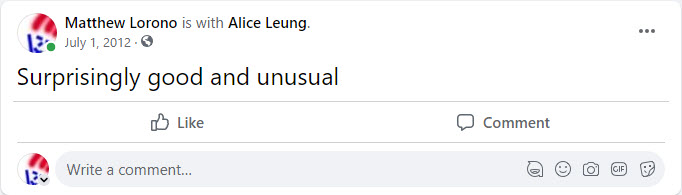
Facebook seems to be broken as a record of past check-ins and other events

In the past, I fairly consistently made frequent check-ins as posts to Facebook for places I visited.  However, it seems Facebook is increasingly deprecating this functionality.  You can still check-in quite easily, but old check-in posts are breaking.  The issue seems to be getting worse over time.  

Facebook was very reliable at one point.  You could look back through your timeline to see what you did, where you did it, and when you did it.  There was even UI that made it easy to choose a time period to peruse.  This was useful for so many reasons, not the least of which is planning for further activities in places you already visited, or providing information to others who planned to visit those places.  Let's also no forget the value of being able to stroll down memory lane.  

Here's an example of one such broken check-in.  It's a post in 2012 that simply says "Surprisingly good and unusual".  The information about where this check-in took place, including the town and other general information has been completely removed.

The posting is useless, other than to verify I did something with Allie on that day.  Fortunately, I also maintain a blog (this blog).  For this particular event, I was able to go back to the day in question and see that Allie and I visited Salem, MA.  I'm not sure which place in Salem is represented by this check-in, however.

I am also finding posts on Facebook where uploaded photos no longer display.  No amount of troubleshooting has restored those photos.  This seems to be particularly problematic for Life Events, where posts which contain one more more photos no longer show those photos.  (These are my own photos that I uploaded to Facebook myself, so it's not an issue of someone else controlling privacy settings or removing their account from Facebook.)  When you edit the post to see what's going on, Facebook seems aware that photos were included in the post because Facebook shows a loading window, but yet that loading window never resolves. When you reupload the photos to the post, you will find that you cannot summit the changed post. Facebook just errors-out on you when you try.

Additionally, even more recently, when I've checked-in at movie theaters for specific movies I'm about to watch, those posts are losing information about the movie.  This is happening for posts that are only a few weeks old, if that.

As of this minute, Facebook is not currently adding post to the Life Events page for any posts dated in 2023.

Given all these issues, and Facebook's track record of similar buggy behavior for other deprecated tools in the past, it seems prudent to no longer rely on Facebook as a record of my past.  This means I have to fall back on my blog.  It's a bit more work to create blog posts than Facebook posts, but at this point, it seems worth the extra trouble.

I've already started replicating past Life Events posts from Facebook on this blog.  

I've been on many business trips, and many of these are interesting destinations. However, I add personal trips as Life Events, yet I don't typically create Life Events posts for common business travel. 

Saturday, July 30, 2022

No one knows why humans have chins? Hmm, maybe I do...

"Humans are the only animal that have a chin, and no one knows why."  Well, I think know why.  Chins acts as a third hand to hold things against your chest when your actual hands are full or otherwise occupied in some sort of tool. Chins are very important for rudimentary tool use, or just lugging things from one place over short distances when your hands are full.  

Sunday, November 21, 2021

The purpose of this blog has changed a bit over the years

The purpose of this blog has changed a bit over the years since Feb 2002.  Early on, I was fascinated by the idea of having an online outlet.  At the beginning, there are literal log entries about what was actually going on in my daily life.  After while, I started covering news items and provided my opinions about stuff.  All the while, there was some self-reflection as well.  I also started a few other blogs that were more focused, including the exploration of alien life, poetry and even my car.  

All of these other blogs have since been retired.  I took postings from those and placed them on this blog.  All but the poetry blog have been deleted.  In fact, around the time I closed down those other blogs, my interest in maintaining a blog waned.  During some of the biggest changes in my life is when I posted the least. 

Then I started using Instagram.  All of a sudden, it was much easier to post about my daily life again, but in a much different way...in the form of images.  Instagram and IFTTT combined allowed me to post every IG image directly onto my blog automatically.  The number of posts increased 10 fold.  I prolly posted text based entries even less than before while I flooded my site with stylized photos.  This continued for several years until IG locked down its API...and then even a bit after that until my other methods of automatically uploading IG posts vanished.

I still post on IG frequently.  Now, to get IG photos on my blog, I actually have to manually add the posts with those photos.  This has actually caused me to post less frequently on IG.  Often, when I transfer the photos, I'll combine related images into a single post on this blog.

In addition to IG, I posted my review of scientific papers about the likelihood of life outside of Earth within our Galaxy.  These posts were very popular and still attract a lot of attention. However, my two most popular posts (that still top my list of activity for this blog)?  Beeper Codes and the related Pager Codes. There's a lot of nostalgia about these codes for some reason.

I'm not writing this post for contemporary consideration.  I absolutely know that this information will not interest anyone today.  But, this ties back to my first sentence above.  The current purpose of this blog, and the one that will stand for here and on?  A while back, I realized I have recorded a snapshot of almost the entire 21th Century to date.  If I keep this blog going (assuming Google continues to support Blogspot), this blog will represent almost the entirety of the first half of the 21th Century.  Nature allowing, I'll try to keep posting until 2052 for a full fifty years.  Although my life may not be very interesting to contemporaries, it may be more interesting as this Century becomes ancient history.  300 years from now, this blog may still be available in some manner within whatever form the Internet will take.  Maybe electronic archeologists will discover my musings buried in archives.  Or, if the world purges the old in such an electronic realm, then this blog or portions thereof may be discovered on some derelict server by dirt-digging archeologists of the 24th Century.  Either way, this is my experience for you.  Yup...you, Magnolia, et al. 

I know the likelihood of the images being kept intact with this blog for a long time are not great, given how Google and other services store them.  I know the likelihood that videos being kept intact are even slimmer.  Here's to hope that somehow forces beyond my control will allow most (all) of this blog to be preserved as a glimpse into the early years of the Information Age.

Saturday, January 09, 2021

The road you didn't take because of a lie

I thought of writing about Robert Frost's poem The Road Not Taken because many (most?) people misinterpret it.  Well, Today I Found Out covered the topic so well, there's no sense in my writing about the poem's meaning.  Please enjoy their video:

The Road Not Taken

Two roads diverged in a yellow wood,
And sorry I could not travel both
And be one traveler, long I stood
And looked down one as far as I could
To where it bent in the undergrowth;

Then took the other, as just as fair,
And having perhaps the better claim,
Because it was grassy and wanted wear;
Though as for that the passing there
Had worn them really about the same,

And both that morning equally lay
In leaves no step had trodden black.
Oh, I kept the first for another day!
Yet knowing how way leads on to way,
I doubted if I should ever come back.

I shall be telling this with a sigh
Somewhere ages and ages hence:
Two roads diverged in a wood, and I—
I took the one less travelled by,
And that has made all the difference..

Friday, December 25, 2020

Do And Die, not Do or Die - common misquote

The poem by Lord Alfred Tennyson called The Charge of the Light Brigade is often misquoted.  Lines 14 and 15 are commonly spoken as "Ours is not to ask why, but to do or die", or something similar.  The key here is that a choice is present; "do or die".  In other words, we follow our orders or be will held accountable.  Or perhaps, do or die trying.

However, within the actual poem (below), such a choice never is present.  The lines are actually "Theirs not to reason why, theirs but to do and die".  The soldiers of the poem never question their order, even though the order is clearly erroneous.  For these soldiers, these six hundred brigaders, a choice is never even in their thoughts.  They would ride headlong into cannon fire, being cut to pieces, while knowing there was no hope of success nor life afterwards.  

When one applies this poem to one's own situation, the phrase "do and die" is far more powerful, potent and critical.  No choice is available, even though the required action surely leads to failure.  In this regard, one might be unintentionally critiquing their orders as folly.

Of course, the poem is poetic. Though the poem does mention some survivors, it romanticizes the sacrifice of the brigade on the whole.  In reality, many of the soldiers survived.  Further, history has characterised the order to charge as a misunderstanding or miscommunication.  However, the order being a mistake of some sort is not undermined by the fact that some brigaders survived.  The Light Brigade was decimated in their charge of the cannons, and that decimation was obviously inevitable. 

The Charge of the Light Brigade

                    I
Half a league, half a league,
Half a league onward,
All in the valley of Death
   Rode the six hundred.
“Forward, the Light Brigade!
Charge for the guns!” he said.
Into the valley of Death
   Rode the six hundred.

                    II
“Forward, the Light Brigade!”
Was there a man dismayed?
Not though the soldier knew
   Someone had blundered.
   Theirs not to make reply,
   Theirs not to reason why,
   Theirs but to do and die.
   Into the valley of Death
   Rode the six hundred.

                  III
Cannon to right of them,
Cannon to left of them,
Cannon in front of them
   Volleyed and thundered;
Stormed at with shot and shell,
Boldly they rode and well,
Into the jaws of Death,
Into the mouth of hell
   Rode the six hundred.

                   IV
Flashed all their sabres bare,
Flashed as they turned in air
Sabring the gunners there,
Charging an army, while
   All the world wondered.
Plunged in the battery-smoke
Right through the line they broke;
Cossack and Russian
Reeled from the sabre stroke
   Shattered and sundered.
Then they rode back, but not
   Not the six hundred.

                    V
Cannon to right of them,
Cannon to left of them,
Cannon behind them
   Volleyed and thundered;
Stormed at with shot and shell,
While horse and hero fell.
They that had fought so well
Came through the jaws of Death,
Back from the mouth of hell,
All that was left of them,
   Left of six hundred.

                   VI
When can their glory fade?
O the wild charge they made!
   All the world wondered.
Honour the charge they made!
Honour the Light Brigade,
   Noble six hundred!

Tuesday, November 24, 2020

Today I just heard the phase "every mushroom cloud has a silver lining" twice from difference sources

Today I just heard the phase "every mushroom cloud has a silver lining" twice from two difference channels on Youtube in different contexts, though both referring to atmospheric nuclear explosions.  One source (11/23/20) was ranting about the ill effects of religious extremism, while the other was talking about how wine vintages from before 1945 cannot be faked today due to worldwide radiation contamination from all the nuclear explosions from WWII and the Cold War (11/22/20). It's a strange phrase to heard twice in one day.

Sunday, November 15, 2020

Things that aren't happening right now

COVID-19
There's a lot of things not happening right now due to covid-time. For me, I've not seen family in a year.  However, it seems there's many who are actually planning gatherings for Thanksgiving.  I hope many reconsider, especially in light of the recent surge in both COVID-SARS-2 cases and related hospitalizations.

Allie and I were lucky to be able to visit Sydney, Australia late last year.  Even still, the Australian fires, which kicked off this crappy year in late 2019 and early 2020, were already starting to consume large regions.  The fires got much worse after we returned home from our vacation.

Allie did get a chance to visit family in Asia in February.  She was very lucky to get back home before things got covid-crazy.  Since then, we've been keeping mostly to ourselves.  Multiple plans to spend time with friends and family were cancelled.  We have no plan to meet other people until covid-time is over.  

That's not to say we've been hiding indoors as shut-ins.  Face masks and copious amounts of the appropriate hand sanitizer are always ready for our visits to the store and other necessary locations.  I've also been working from home almost 100% of the time, only going into the office (after site approval) a couple of times to access specific stuff on my work desktop computer or paperwork at my desk.

I am weary of the need to keep vigilant against the nasty virus.  However, out of love for my neighbor (and of course, family members), my resolve is not weakened.  


Month Event
January Australia fires
February Africa locust plague begins
March COVID-SARS-2 explodes
April Relatively minor events
May George Floyd's horrific murder
June Worldwide protests about George Floyd's murder
July Multiple natural disasters in Asia
AugustBeirut explosion
September Western US fires
October Terror attacks in France
November Massive COVID-SARS-2 resurgence
December Arecibo Observatory collapse
January 2021 Riot on Capitol Hill

Thursday, October 08, 2020

The Three Theys of Interstellar

Interstellar movie
I'm not going to explain everything about Interstellar. I'm just going to jump right into the discussion.  Please watch the movie Interstellar, if you haven't.  Or, if you haven't seen the movie in awhile, watch it again.  Here's my "film theory" about Interstellar's supposed Bootstrap Paradox, "The Three Theys of Interstellar".

The third "they"

The movie Interstellar runs deep with current known science and also notions of time (in a manner that is not well-enough understood by science).  In the movie, there are several discussions that refer to "they" as the architects (my word) of the events within the movie.  "They" is used to refer to the creators of the wormhole, the same wormhole that brings humans to a distance galaxy to find habitable worlds.  "They" is also used to describe the creators of the tesseract within Gargantua Black Hole into which Cooper falls.  There's actually a third "they" used by Brand (daughter of Professor Brand) where she unknowingly shakes Cooper's hand while she's in the wormhole and while the tesseract collapses around Cooper.  She mistakenly refers to Cooper as "them".

The second "they"

While in the tesseract, Cooper hypothesizes (or guesses) that "they" are future descents of humans.  When viewing the movie's narrative superficially, "they" are the ones who set everything up to allow colonization of distance worlds, and also to allow Cooper to survive within the Black Hole long enough to send back the necessary data  to solve Professor Brand's equations. The movie does not provide any further explanation, but does hint that Cooper's guess is not 100% accurate.  This hint comes when he becomes third "they" during the aforementioned handshake with Brand.  Also, Tars specifically calls the creators of the tesseract by the moniker "Bulk Beings".  

Cooper's explanation for "they" is flawed.  If "they" are our descents and also the creators of the wormhole, this forms a "Bootstrap Paradox". If the wormhole didn't exist, we'd have no ability to save humanity in order to have our descents create the wormhole.

Getting stuck on this Bootstrap Paradox assumes this movie presents the final and accurate explanation for "they" or the "Bulk Beings'.  However, if the creators of the wormhole are different from the Bulk Beings (creators of the tesseract), the paradox evaporates.

The first "they"

Cooper was right in his guess that we were solving our own problems.  We got our selves to the wormhole.  We investigated several habitable worlds on the other side.  Cooper himself fell into the Black Hole and interacted with Murph.  However, what's the moment that prevents the paradox and allows Bulk Beings to exist?  This moment is when Brand colonizes Edmond's Planet.  Her colony saved the human species, but not humans on Earth.  Her colony's eventual descents (the Bulk Beings) had to finish the job.  They had to enable the survival of humans on Earth.  They did so by creating the tesseract for Cooper inside of Gargantua.

So, who are the creators of the wormhole that kicked off human survival?  Who are the first "they" of Interstellar?  My best guess is that "they" are simply an interested party who provided us with a way to save ourselves, if we are ready to be saved.  The first "they" of Interstellar are different non-human related beings who were possibly even more advanced than the Bulk Beings.

Friday, September 11, 2020

Baseball obscure stat

Baseball obscure stat:  In modern era of Major League Baseball, no game has ever had an unassisted triple play in either the 3rd or 8th innings.

Friday, August 28, 2020

Charities suck and you suck for supporting them?

Presentations that provide misinformation or misrepresentations regarding charities are common.  Awhile back I ran into this seemingly well-meaning Youtube video  (below)  that attempts to expose the dirty underbelly of charities.  Normally, I don't promote content I see as wildly or widely off-base.  However, in this case, I feel it's important to see the earnest and confidence of the presentation and still be able to peer through the facade to come face-to-face with the video's deep flaws.

I've worked with funding of charities in the past.  After viewing this video, something just feels off about its presentation.  It's as though Thought2 (pronounce "42") is trying to promote an agenda of lowkey fearmongering rather than provide accurate information.  

Yes, administrative costs exist and are typically a large amount of where the donations are used in a well-run organization.  However, this video makes it sound like there are dozens if not hundreds of people on charity payrolls.  The truth is that most locally managed charities are scraping by with just a few people, who are often volunteers, in makeshift or hand-me-down office spaces.  

Yes, some charities are short-sighted in their march to achieve artificially important goals.  However, the video's example of water pumps drastically misses the point: most communities that were helped do have working water pumps, even if many do not.  

The video's example regarding clothes and electronic donations is also far off the mark.  As stated by another Youtube commenter (Tripe): 

"Blaming the entire collapse of the Kenyan textile market on imports isn't reality. He does state "domestic market" at one point, but that isn't the data he presents.  He blames charity for the loss of 500000 jobs, but those people were serving the entire industry, not only the domestic market. The same issues that lead to the collapse of exports were still affecting the domestic market as well.  They've had loads of problems including tariffs, labor prices, port prices, high energy costs, stiff competition from Asian countries, corruption, outdated machinery, credit problems, trade reforms and more. I think it would be more accurate to say imports are one of the factors that lead to the downfall of the domestic textile market and are currently retarding the resurgence of the domestic textile market in Kenya, (if they have the leadership for such a resurgence),  not the main cause of the collapse and the loss of 500000 jobs."

Also, I found the video's focus on Africa-support charities produces a dramatically skewed story.  IRL, many charities are for local benefit, so don't have same economic effects about which this video speaks.   Thoughty2 seems to be heavily focused on big-picture and grand-gesture charities.  The charity rating services that are mentioned in the video are heavily focused on these types of charities too.  This video makes no mention of rape crisis centers, suicide hotlines, or local food banks.

Oh, United Way also locally audits the charities that they support using similar criteria as the organization that this video promotes.  United Way audits charities within each community separately.  This means that even national organizations are audited at a local level to justify their funding in that area.  The problem with organizations that publish charities ratings is that the numbers are often misleading, with too much emphasis placed on making "administrative costs" out to be a bad thing.  Due to the nature of some charities and the location of the people they help, costs are naturally higher for some charities over others. United Way funds charities without making the mistake of assuming administrative costs are somehow bad just because.

I'm not sure if this video is well-intended, or if it intentionally misleads.  Either way, in my opinion, this video is completely unreliable for the topic of charities and should not be used as a reference in discussions regarding charities.