| SC # | Movie | Box Office (WW) | My # | My Comments |
|---|---|---|---|---|
| 1 | Avengers: Endgame (2019) | $2.80 billion | 3 | Thoroughly enjoyable and satisfying conclusion to the MCU Phase 3 and the Infinity Saga. |
| 2 | Avengers: Infinity War (2018) | $2.05 billion | 2 | To me, Infinity War is a better movie overall than Endgame, as the pieces all come together for the biggest cliffhanger in movie history. |
| 3 | Top Gun: Maverick (2022) | $1.50 billion | 9 | This is a very enjoyable movie with an extremely simple and formulaic plot. |
| 4 | Titanic (1997) | $2.26 billion | 1 | A showcase of human interactions with all our flaws and selfish actions on full display, told in a way that changes our perspective of an history event while honoring those who lost so much from it. |
| 5 | The Odyssey (2026) | $1.46 billion+ (still in theaters) | 6 | An awesome telling of the historic classic tale, but perhaps would've benefited with updated storyline to smooth over elements of the original epic that no longer function with our current understanding of the World, such not having Hell be an actual physical location to which one could sail. |
| 6 | The Avengers (2012) | $1.52 billion | 7 | The OG of cinematic universe culminations which brought Phase 1 of the MCU to an exciting and hopeful conclusion. |
| 7 | Inside Out 2 (2024) | $1.70 billion | N/A | I've never seen this movie, but not against seeing it at some point. |
| 8 | Spider-Man: Brand New Day (2026) | $2.23 billion+ (still in theaters) | 8 | Fun movie that brings together many different elements from diverse origins within the greater Marvel Comics mythos, though it may have covered too many topics, as some plotlines where left without full resolution. |
| 9 | Frozen II (2019) | $1.45 billion | N/A | I've never seen this movie and not interested in going out of my way to see it. |
| 10 | Spider-Man: No Way Home (2021) | $1.92 billion | 11 | Exciting movie that expands the scope of Spider-Man mythos, but had more fan service than actual plot. |
| 11 | Star Wars: The Force Awakens (2015) | $2.07 billion | 14 | An interesting retelling of Star Wars: A New Hope in a manor that forced Star War movies into a very cyclical and repetitive story arc. However, this movie is diminished even more by the lack of story cohesion from its sequel. |
| 12 | Jurassic World (2015) | $1.67 billion | 12 | Fun movie that forces the Jurassic Park movies into a very cyclical and repetitive story arc. |
| 13 | Avatar: The Way of Water (2022) | $2.32 billion | 10 | A great return of the Avatar franchise that becomes diminished by a repetitive and yet superior sequel. Had Fire and Ash come out first, this movie would have been unnecessary. |
| 14 | Avatar (2009) | $2.92 billion | 4 | The OG "must see in 3D" movie that tells a well thought-out story while introducing a new cinematic Universe. |
| 15 | Furious 7 (2015) | $1.52 billion | N/A | I've never seen this movie and not interested in going out of my way to see it. |
| 16 | Zootopia 2 (2025) | $1.80 billion+ (still in theaters) | 15 | Enjoyable film, but with a story that is inferior to the original Zootopia movie in almost every way. |
| 17 | Barbie (2023) | $1.45 billion | 13 | This is a fun flash-in-the-pan experience that likely won't be repeated, at least not within the genre of movies derived from toy IP. |
| 18 | Avatar: Fire and Ash (2025) | $1.48 billion+ (still in theaters) | 5 | Enjoyable film. Its unfortunate this movie will always be compared with The Way of Water since this movie is better in almost every way, though it repeats much of the plot from its predecessor. Its a great movie that fleshes out the Avatar cinematic Universe. |
| 19 | Ne Zha 2 (2025) | $2.2 billion | N/A | I've never seen this movie and not interested in going out of my way to see it. |
| 20 | The Lion King (2019) | $1.66 billion | N/A | I've never seen this movie and not interested in going out of my way to see it. |
Showing posts with label Opinion. Show all posts
Showing posts with label Opinion. Show all posts
Monday, August 31, 2026
Ranking the 20 Highest Grossing Movies (so far)? Yup!
Sean Chandler has an interesting take on the top 20 grossing movies of all time, not taking into account inflation or the change of what a movie ticket represents over time. You can see his list on his video. Under that, I've provided my own brief comments and ranking next to his ranking for my own thoughts about these various movies.
>

Thursday, June 25, 2026
Fun and Important Words - Malarkey
Malarkey is a colorful and punchy term for nonsense or foolishness. It can also be used to describe insincere or exaggerated talk. It is a word that carries a specific weight when you use it to dismiss claims or excuses as hogwash. While it has become a staple of American political discourse, it remains an informal, playful and expressive way to call out empty rhetoric. [1] [2] The origin of the word is famously murky, which is fitting for a term that means nonsense. Evidence points to its emergence in North America during the early 1920s. The first known use is often attributed to the Irish-American cartoonist Thomas Aloysius (Tad) Dorgan, who began using the term in his cartoons in Mid-1920s. By the end of that decade, the word had begun to appear more widely in print. [3] Despite various theories, the etymology remains officially unknown. Some linguists and researchers have suggested potential links to the Greek word malakia, which can mean softness or, in a figurative sense, effeminacy or weakness. Others have pointed to the Irish surname Mullarkey (and its various spellings), though there is no verified connection between any individual of that name and the word’s development. There is even a niche theory suggesting it might be related to the London expression Madame Misharty, a personification of wild sales talk. Still another possibility is some use of the Gaelic root word "meall-", which means being deceptive or lying. [3] Because the word began as slang in the United States, it is not traditionally found in older printed dictionaries from the 19th century. However, it is now widely recognized in major modern dictionaries as a standard, though informal, English noun. [3] According to Google ngram, common use of malarkey appears in the 1920s and then took off in the 1930s. |
 |
Thursday, February 12, 2026
Will the Gaming Industry Change Use of FPS and TPS?
The Inertia of Familiar Language
The traditional definitions of first- and third-person games rely on camera placement rather than on player agency. That shortcut has distorted how we talk about perspective for decades.
So why has this never been corrected? The short answer is likely inertia.
Once a term becomes familiar, widely taught, and commercially useful, it stops being descriptive and starts being infrastructural. Changing it becomes expensive, not just financially, but culturally.
The FPS Effect
The modern taxonomy of game perspective crystallized in the 1990s with the rise of the first-person shooter (FPS).
“FPS” was an unusually successful label:
It described what players saw
It differentiated a new genre
It was easy to market
It spread quickly through magazines, retail shelves, and early web discourse
Once first person became synonymous with “camera at eye level,” everything else was forced into contrast. The term third person did not emerge from narrative theory. It emerged as whatever FPS was not.
This asymmetry locked the vocabulary in place before anyone had reason to question it.
Camera Language Is Easier Than Agency Language

It is far easier to say:
The camera is behind the character
than to say:
The player issues commands to a represented self
Marketing departments, tutorial writers, and reviewers naturally gravitated toward the simpler explanation. Over time, that simplification hardened into definition.
Once perspective was taught as a visual property, revisiting it as a player–system relationship required more effort than most discourse was willing to invest.
How Designers Commonly Talk About Perspective
In public-facing discourse, perspective is usually described in terms of camera placement. In design-facing discussions, however, the vocabulary often shifts.
Designers frequently frame perspective through concepts such as:
Player embodiment
Identification with an avatar
Degrees of abstraction
Command versus inhabitation
Latency between decision and action
These ideas appear regularly in design talks, postmortems, and critical writing, even when the traditional labels of first- or third-person remain in place. The emphasis is less on where the camera sits and more on how the player relates to what they control.
This does not mean designers uniformly reject camera-based terminology. Rather, it suggests a practical distinction: the internal language of design often exceeds the precision of the public labels used to describe games.
In other words, the mislabeling persists not because designers lack conceptual tools, but because those tools are rarely reconsidered in player-facing taxonomy.
Why the Industry Is Unlikely to Fix the Labels
Even if the argument is sound, several forces resist change:
1. Legacy Vocabulary
Decades of books, articles, reviews, and tutorials use the existing terms. Revising them would create friction with historical material.
2. Search and Discovery
“Third-person action game” is a deeply indexed phrase. Replacing it would damage discoverability without offering immediate commercial upside.
3. Audience Expectations
Players already believe they know what these terms mean. Correcting them risks sounding pedantic or confusing, even when accurate.
4. Mixed Perspectives
Many modern games blur categories intentionally. Studios may prefer flexible ambiguity to precise taxonomy.
Taken together, these pressures make formal correction unlikely.
Why This Still Matters
If the industry is not going to change its labels, why insist on the distinction at all?
Because language shapes analysis.
Mislabeling perspective:
Obscures why certain games feel immersive despite external cameras
Confuses discussions of agency and control
Flattens meaningful differences between avatar play and command play
Makes serious criticism sound mystical rather than structural
A player-centric model gives critics, designers, and players a sharper vocabulary; even if public-facing labels remain unchanged.
The Value of a Parallel Vocabulary
This series is not a call to rename genres overnight. It is a proposal for a parallel framework that can coexist with existing terminology while offering greater precision.
Just as film studies distinguish between camera angle and narrative voice, game analysis benefits from separating:
What does the camera do
What is the player representation
Keeping these concepts distinct allows deeper discussion without breaking compatibility with established language.
A Useful Mental Reframe
Rather than asking:
Is this game first person or third person?
Ask:
Who is acting?
Who is being addressed?
Where does the player exist in relation to the system?
These questions remain valid regardless of genre, technology, or trend.
Keeping It Going
The industry is unlikely to abandon camera-based labels. They are too entrenched, too useful, and too familiar. But clarity does not require replacement. It requires recognition.
We can say that a game has first-person perspective with third-person camera angle. Or, a game is second-person perspective with the ability to show either game-piece camera angle or top-down third person camera angle. Such descriptions are more meaningful.
Once we understand that most so-called third-person games are structurally second-person, a great deal of confusion dissolves. Design intent becomes clearer. Player experience becomes easier to articulate.
Also see
Tuesday, February 10, 2026
Full Day Lord of the Rings Mavora Lakes Adventure

However, while visiting these filming locations was great, the travel between them is a bit rough. This is the nature of travelling around the South Island of New Zealand in this region, especially when you are leaving paved highways behind for a time. The tour length definitely adds to discomfort as much as the roads themselves since this is a 10 hour tour, with long stretches between locations. Just be prepared. One bit of advice is to pack your own lunch, as I found the location where food was available to purchase to be rather lacking.


Instagram: https://www.instagram.com/p/DUefP6dgWfQ/?img_index=1 and https://www.instagram.com/p/DUego49AVOc/?img_index=1
Besides the thrill of discovering so many filming locations in one tour, we also got to see much of the beauty of South Island's mountains and lakes. It feels like New Zealand was always meant to be the location of Middle Earth.
Check out our other explorations around Queenstown on this trip, including arrival to Auckland a day late.
Sunday, February 08, 2026
Real-World Games and Player Perspective
Why Physical Games Clarify the Debate
If digital games complicate questions of perspective with cameras, avatars, and simulated worlds, real‑world games strip those ambiguities away. There is no virtual camera, no rendering engine, and no ambiguity about where the player exists in relation to play.
What remains is the core relationship that person actually describes: how the player is positioned relative to action and agency.
When we apply the same player‑centric framework to physical and tabletop games, the mislabeling of digital perspectives becomes immediately obvious. The categories align cleanly without edge cases, caveats or special pleading.
First Person: Embodied Physical Play
In first‑person games, the player is the acting body. There is no representational layer.

Examples
Tag
Soccer, basketball, martial arts
Darts, bowling
Poker (as bodily participation rather than avatar play)
Perspective Structure
The player acts directly
The player’s body is the locus of agency
There is no token, piece, or proxy
The language of play is unambiguously first person:
I run.
I throw.
I bluff.
No one meaningfully describes these games as issuing commands to a representation. There is no interpretive distance between decision and action.
This is first‑person perspective in its purest form, mapping precisely onto digital first‑person games where avatar and player identity collapse into one.
Second Person: Token‑Mediated Play
Second‑person play emerges the moment a personal proxy is introduced.
Examples
Monopoly
The Game of Life
Sorry!
Most role‑playing board games
Perspective Structure
The player is personally represented
Actions are issued to a token
The token is “you,” but not identical to you
The language shifts naturally:
You move three spaces.
You pass Go.
You go to jail.
No one confuses the plastic token with the player’s physical body. No one treats the token as an unrelated entity either. It is unmistakably you, addressed directly.
This is the exact structural relationship found in traditionally labeled “third‑person” digital games:
A visible body
A controllable character
A personal avatar that can be observed, directed, and positioned
The tabletop world exposes the truth that digital cameras obscure: this is second‑person play.
Third Person: Unembodied Command
True third‑person perspective appears when the player has no personal representation at all.
Examples
Chess
Checkers
Go
Wargames with multiple units per side
Perspective Structure
No piece represents the player
All entities are equally external
The player exists entirely outside the system
The language reflects this detachment:
That piece captured the queen.
These troops were sacrificed units.
That side is losing control of the board.
Even when players identify emotionally with a side or strategy, no single piece is you. The relationship is observational and managerial rather than embodied.
This maps cleanly onto digital strategy games, god games, and simulation titles where the player’s presence is abstract, systemic, or omniscient.
Why These Categories Feel Obvious Offline
In physical games, no one argues that Monopoly is “third person” or that chess is “first person.” The distinctions feel intuitive because:
There is no camera to confuse viewpoint with identity
Tokens and the actual human self are physically distinct
Agency is visibly mediated or not
Digital games inherited linguistic categories before these distinctions were fully examined. Real‑world games demonstrate that the confusion is not conceptual, but rather it is terminological.
The Consistency Test
A useful diagnostic question emerges:
If this game were played on a table instead of a screen, what would represent the player?
Your body → First person
Your personal token → Second person
Nothing at all → Third person
This test holds across media, genres, and technologies.
Implications for Game Analysis
Understanding perspective through real‑world analogs helps clarify:
Why some games feel intimate despite external cameras
Why avatar visibility changes player psychology
Why command‑based games encourage strategic rather than empathetic thinking
Why VR intensifies embodiment without redefining perspective
Most importantly, it reinforces the fact that perspective is about player–action relationships, not visual framing.
Looking beyond
Real‑world games quietly and intuitively preserve the original linguistic meaning of person in the terms of first-, second- and third-person. When we let them inform our understanding of digital play, the long‑standing mislabeling of game perspectives becomes impossible to ignore. The camera never determined perspective; the player's relationship within the game makes that determination.
Also see:
Friday, February 06, 2026
A Player-Centric Model of Game Perspective
 From Definitions to Application

The previous article in this series established a narrow but important claim: camera angle does not determine narrative person. "Person" in "first-person" describes who acts, not where the camera viewpoint is placed.
Taking this into consideration, let's apply the concept directly to video games. Doing so requires shifting perspective from what the player sees to how the player is represented within the game system.
This article proposes a player-centric model of perspective and uses it to reëxamine the three categories commonly described as first-person, second-person and third-person.
A Player-Centric Definition of Perspective
Rather than anchoring perspective to the camera, this model defines person by the relationship between the player and the acting entity in the game world.
| Person | Defining Question | Player Relationship |
|---|---|---|
| First | Am I the body acting? | Player and avatar are the same entity |
| Second | Am I directing a represented “you”? | Player controls a personal avatar |
| Third | Am I commanding others? | Player is unrepresented in the world |
This framework does not replace existing camera terminology. It runs alongside it. A game can still be described as having a first-person perspective with a third-person camera. What changes is how we describe player perspective.
First-Person Games: “I Move Here”
In first-person games, the player and the avatar collapse into a single acting subject. There is no meaningful distinction between the decision-maker and the body that carries out those decisions.
Common examples include:
Doom
Counter-Strike
Mirror’s Edge
Most virtual reality titles
Player intent is expressed directly as action:
I reload.
I lean around the corner.
I jump.
The defining feature is not the absence of a visible character model. It is the absence of narrative distance. The player does not instruct a character. The player acts.
The Misnamed Middle: Games Labeled “Third-Person”
Most action and role-playing games are grouped under the label of third-person:
Tomb Raider
The Witcher
God of War
PUBG
This category is where the traditional terminology begins to fail.
In these games, the player does not fully inhabit the avatar in the way first-person play requires. The character on screen is visible, persistent, and separate. The player does not experience the world as the body. The player directs the body.
The internal language of play reflects this relationship clearly:
You roll.
You climb.
You draw your weapon.
This is not metaphorical. It is structurally second person. The avatar represents the player, but the representation is mediated. The player and the character are not the same acting subject.
What distinguishes this middle category is not camera distance, character visibility, or animation style. It is addressability. The player addresses a personal avatar that exists as an object in the game world.
That distinction matters. A player can empathize with, customize, and narratively identify with an avatar while still relating to it as "you" rather than "I." The presence of dialogue choices, equipment management, and movement commands reinforces this relationship. The player tells the character what to do. The character then does it.
The camera makes this separation obvious, but it does not create it. Even if the camera were forced to overlap the character’s head, the underlying relationship would remain unchanged as long as the player continues to issue instructions to a represented self.
The moment a player can observe their own body as something acted upon, perspective has already shifted away from first person.
This is the core of the mislabeling. These games are neither first-person nor third-person in the narrative sense. They occupy a distinct middle ground that aligns cleanly with second-person structure.
True Third-Person Games: “They Move There”
Third-person perspective, in the narrative sense, emerges when the player is not embodied at all.
Strategy and command-based games provide clear examples:
Civilization
X-COM
Command & Conquer
StarCraft
Here, the player does not control a personal avatar. Instead, they direct multiple agents, units, or factions.
The language of play naturally changes:
They advance the unit.
They lose morale.
They capture the city.
Even when the game provides a narrative role such as ruler, commander, or overseer, that role is abstract. No single entity in the game world stands in for the player.
This aligns cleanly with third-person narration in literature. The player observes and directs, but does not inhabit.
A Shift in Perspective
Reframing game perspective around player representation reveals a gap in the familiar terminology. What has long been labeled third-person gameplay occupies a distinct middle ground that matches second-person structure far more closely than third.
This does not mean existing labels must be discarded. It does mean they should be understood as describing cameras rather than perspective.
The next article in this series steps away from digital games entirely. By examining board games and other real-world play, it becomes easier to see why camera-based definitions were always an awkward fit.
Continue to Part III: Real-World Games and Player Perspective.
Saturday, January 31, 2026
We’ve Been Using “Third-Person” Wrong for 30 Years in Gaming
A Comfortable Mistake
Video games are routinely sorted into neat perspective boxes: first-person and third-person. The terms feel intuitive, established, and beyond dispute. An FPS shows what the character sees. A third-person game shows the character from the outside. A second-person game doesn't truly exist, per se. Case closed.
Except that this framing quietly borrows language from literature and then uses it incorrectly.
In grammar and narrative theory, person is not about camera placement. It is about who is the acting subject. Once we apply that definition consistently, a strange realization emerges: what the games industry has long called third-person does not actually describe a third-person relationship at all.
This article is the first in a short series. Its purpose is not to reclassify games yet, but to clear conceptual ground. Before we can argue about first, second, or third person in games, we need to be precise about what those terms mean.
Camera Angle Is Not Narrative Person
Before redefining perspective, one clarification is essential: camera angle does not establish narrative person.
Games inherited the terms first-person and third-person largely through visual analogy. The distinction became shorthand for what the player sees on screen, not for how the player is positioned within the system of action. This shortcut made the terminology easy to teach, but conceptually unstable.
In literature and narrative theory, a scene can be described from any imaginable vantage point without changing grammatical person. A third-person novel may describe events from directly behind a character’s eyes. A second-person text may position the reader outside their body. A first-person account may briefly describe the narrator from an external viewpoint for dramatic effect.

By tying person to camera placement, game discourse quietly collapsed two distinct ideas:
Cinematography: where the viewpoint is located
Narrative person: who the acting subject is
Untangling these concepts is the key to understanding why the familiar labels begin to break down under closer inspection.
What “Person” Actually Means
In language and literature, person refers to the relationship between the speaker and the subject of action:
First person: I act ("I walk down the road")
Second person: You act ("You open the door")
Third person: They act ("She draws her sword")
Person describes agency and identity, not point of observation. It answers a simple question: who is doing the acting?
This definition has remained stable across centuries of grammar, rhetoric, and narrative theory. What changes from medium to medium is not the meaning of person, but the techniques used to express it.
Game terminology drifted away from this definition by anchoring person to the camera rather than to player representation. Once that shift occurred, the labels continued to function socially even as they lost their original precision.
Clearing the Ground
At this stage, no games need to be reclassified. The only claim established here is a foundational one: camera placement and narrative person are not the same thing.
If person is understood as a question of who acts rather than where the camera sits, the familiar categories of game perspective become less stable and more interesting. Some labels begin to feel strained. Other labels begin to feel incomplete.
The next article in this series builds on this groundwork by proposing a player-centric definition of perspective and applying it directly to video games.
Continue to Part II: A Player-Centric Model of Game Perspective.
Monday, March 31, 2025
Monkeydactyl: Pterosaur to Human?
Imagine a world where pterosaurs didn't just soar, but swung through trees like monkeys. A recent discovery in China suggests this might not be pure fantasy. A few years ago, paleontologists unearthed a remarkable pterosaur fossil: a creature with opposable thumbs. This species, Kunpengopterus antipollicatus (nicknamed 'Monkeydactyl'), lived roughly 160 million years ago and represents a pivotal moment in pterosaur evolution. It's important to clarify that while often mistaken for dinosaurs, pterosaurs were a distinct group of flying reptiles, closely related to, but separate from, the dinosaurs.
Though Monkeydactyl retained a classic pterodactyl-like body, its unique thumb structure hints at a potential shift towards arboreal life, perhaps even capable of navigating the forest canopy and soar above it.

The discovery of Kunpengopterus antipollicatus establishes it as the earliest known reptile, and indeed one of the earliest animals, to possess opposable thumbs. This unique adaptation, coupled with the fossil site's rich assemblage of 150 other arboreal species, strongly suggests that Monkeydactyl thrived in a densely forested environment. It's fascinating to consider that this ancient habitat shares similarities with those inhabited by early Homo sapien ancestors.
Given this context, it's not entirely unreasonable to speculate that descendants of Monkeydactyl might have undergone convergent evolution, developing traits analogous to modern monkeys and apes. Some lineages could have become increasingly specialized for arboreal life, exhibiting monkey-like features. While other branches might have evolved distinct adaptations, perhaps even resembling the mythical griffin, if we allow our imagination to roam. In such scenarios, the selective pressures of a forest environment could have led to the gradual reduction or even complete loss of wings in certain pterosaur lines.


Imagine, if the ancient forests had shifted and opened into vast grasslands, much like the cradle of humanity in Africa. What if a flying creature became a climber? What if it then stood tall, abandoning the trees? What if, instead of wings, it held tools with hands to shape its world?
A different path, a different mind, born from the same relentless dance of life, yet utterly alien from our own experience. Perhaps, in some other twist of fate, the echo of our own story could have been a song sung by kin with elongated snouts and covered with pycnofibers. Evolution's canvas is far wider, wilder, and weirder with the slightest environmental change.

Let your imagination take flight. What other extraordinary forms might evolution have sculpted, given a different turn of the cosmic wheel?
Related articles
Thursday, March 14, 2024
Godzilla Minus One does not deserve their Oscar

Also, Guardians of the Galaxy 3 (GOTG3) has a big advantage. In GOTG3, a lot of completely CGI characters that are so well done, you forget they are CGI. In my opinion, both The Creator and GOTG3 are far superior films than G-1 in terms of VFX. In particular, GOTG3 was robbed. However, that wouldn't be so bad if The Creator won instead. But to give the award to G-1 instead of either of those two? Yikes.
I have seen all three of these movies in the theater on the biggest screens available for each.
Wednesday, January 24, 2024
New Flag Design in Planning for Illinois
Back in August of 2023, the State of Illinois started the process to design a new flag for the state. From the announcement, I'm not sure if the process will take suggestions from the public directly. Instead, there's going to be a relatively huge design committee, though.
Vexillologically speaking, the current state flag is not a good design. Problems include:
- A complex image directly pulled from the State Seal, where details are lost in the cluster and not easy to draw;
- As a result, the flag also has too many colors;
- Unnecessary, distracting, redundant and poorly placed text "ILLINOIS".

The only thing that makes this flag distinct when comparing it to other state flags is the white background. Other than that, from a glance, you wouldn't know if this was the flag for Michigan, North Dakota or Vermont.
One interesting fact is that Illinois created anniversary flags. I think the answer for a new flag design lies in the Centennial flag.

This flag isn't perfect, but it's much better and more distinctive. I think this would make a great basis for the new state flag. Here's what I would consider to change in order to adopt this flag as the new state flag:
- I don't think the star fields are necessary, as these represent other states and not Illinois itself;
- The design looks like a missile (or even something rude) in modern aesthetics.
I would remove the star fields and move the white star to the center.

This concept is historic, unique when compared other states, easily recognizable on its own, and simple enough for grade school children to draw from memory. It also falls in line with the regional motif established by the Chicago flag; while offering more strength of design by being even more succinct.

It should be noted that Wallace Rice designed both the Chicago flag and the Illinois Centennial flag.
Thursday, December 28, 2023
Saturday, August 05, 2023
Possible resurrection of the landing page
In the early days of the internet, landing pages were often little more than menus that website visitors use to navigate to different pages and sites. Software at the time also heavily relied on menu-based interfaces. Even the most expensive applications had very simple menus as their landing page, often called "main menu".


After seeing the concept of the landing page undergoing a resurrection, I decided it was time to refresh my own. My new landing page has been active for a few months. It was modernized to be flexible, allowing it to display correctly on both phones and computers. It's still very simple, but it has some previews of content. It has no ads (yet) and no tracking. It's literally just a menu of my personal web across the internet.

However, for decades, forcing users into a main menu or other landing page has been considered bad user interface design. Menus were moved from the opening screen to the top bar, bottom bar, and even along the sides of the window/screen. For a long time, applications would open directly into the application's workspace, where users would then navigate menus to open files. Similarly, websites commonly started directly on the content page, with navigation moved to the sidebar.
About ten years ago, user interface design started to shift back to special pages for operational activities such as opening documents. Let's call these collectively as "operations pages." Microsoft Office returned to the idea of a special page for operations in recent versions, though these pages are optional. Other applications also now have operations pages that are not optional. (These are sometimes called splash pages.) The interfaces of these operations pages vary quite a bit from application to application, with many applications (including Office applications) trying to use all the extra real estate to provide some additional functionality.
Linktree
In 2016, Linktree came along and rebranded the old-fashioned landing page. It was created because social media websites don't allow their users to place more than one website in their profile pages. Linktree hosts a page that acts as a personal landing page for all of your various social media profiles. Linktree is a bit fancier than what was used in the 1980s and 1990s, but functionally identical from the perspective of the website visitor. From the perspective of the Linktree's customer, it provides some useful services for a fee (such as tracking visitor data).
There are now other Link in Bio hosting services as well.
WordPress
In 2023, WordPress is finally getting into this game with w.link. WordPress supports the creation of a landing page that looks very similar to Linktree's concept. The advantage of WordPress' solution is that users can self-host their landing page. Even with self-hosting, WordPress still offers some useful services for a fee.
However, for users who are already self-hosting and don't need those additional services, there's no need to use Linktree, WordPress, or any other "Link in Bio" services. You can just make your own landing page with relatively few lines of code in an HTML file.
fcsuper's place
I've literally been using a landing page from day-one on my website fcsuper.com (since mid-aughties). I'm sure many of my visitors over the years sneered when they arrived upon my original landing page. My original landing page was ugly, but functional.
After seeing the concept of the landing page undergoing a resurrection, I decided it was time to refresh my own. My new landing page has been active for a few months. It was modernized to be flexible, allowing it to display correctly on both phones and computers. It's still very simple, but it has some previews of content. It has no ads (yet) and no tracking. It's literally just a menu of my personal web across the internet.
However, this has now led me to a new thought. Should I make two landing pages: one for my truly personal activities, and one for my career-related activities? I guess I'll figure that out soon enough.
Tuesday, May 02, 2023

Friday, April 28, 2023
Likely wrong, but verify your local laws to be certain

In the US, the rule for which lanes you are allowed to take on turns varies by state. However, the rule shown in this image is likely untrue in most places. Instead, more often than not, the right-of-way driver is allowed to pick their lane.
Of course, this post isn't legal advice, so check local laws to know the rule for your area. However, many people mistakenly believe their state allows them to turn when they don't have the right-of-way. A better rule is to always yield to right-of-way, regardless (because you never know what the other person is going to do).
Instagram: https://www.instagram.com/p/CoAecNjOu5Q/
Friday, February 10, 2023
Facebook seems to be broken as a record of past check-ins and other events
In the past, I fairly consistently made frequent check-ins as posts to Facebook for places I visited. However, it seems Facebook is increasingly deprecating this functionality. You can still check-in quite easily, but old check-in posts are breaking. The issue seems to be getting worse over time.
Facebook was very reliable at one point. You could look back through your timeline to see what you did, where you did it, and when you did it. There was even UI that made it easy to choose a time period to peruse. This was useful for so many reasons, not the least of which is planning for further activities in places you already visited, or providing information to others who planned to visit those places. Let's also no forget the value of being able to stroll down memory lane.
Here's an example of one such broken check-in. It's a post in 2012 that simply says "Surprisingly good and unusual". The information about where this check-in took place, including the town and other general information has been completely removed.
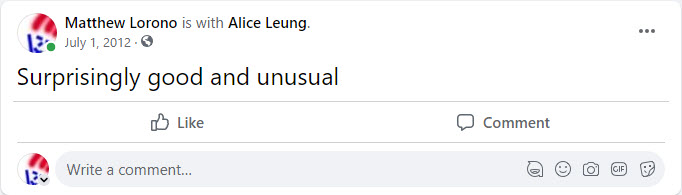
The posting is useless, other than to verify I did something with Allie on that day. Fortunately, I also maintain a blog (this blog). For this particular event, I was able to go back to the day in question and see that Allie and I visited Salem, MA. I'm not sure which place in Salem is represented by this check-in, however.
I am also finding posts on Facebook where uploaded photos no longer display. No amount of troubleshooting has restored those photos. This seems to be particularly problematic for Life Events, where posts which contain one more more photos no longer show those photos. (These are my own photos that I uploaded to Facebook myself, so it's not an issue of someone else controlling privacy settings or removing their account from Facebook.) When you edit the post to see what's going on, Facebook seems aware that photos were included in the post because Facebook shows a loading window, but yet that loading window never resolves. When you reupload the photos to the post, you will find that you cannot summit the changed post. Facebook just errors-out on you when you try.
Additionally, even more recently, when I've checked-in at movie theaters for specific movies I'm about to watch, those posts are losing information about the movie. This is happening for posts that are only a few weeks old, if that.
As of this minute, Facebook is not currently adding post to the Life Events page for any posts dated in 2023.
Given all these issues, and Facebook's track record of similar buggy behavior for other deprecated tools in the past, it seems prudent to no longer rely on Facebook as a record of my past. This means I have to fall back on my blog. It's a bit more work to create blog posts than Facebook posts, but at this point, it seems worth the extra trouble.
I've already started replicating past Life Events posts from Facebook on this blog.
I've been on many business trips, and many of these are interesting destinations. However, I add personal trips as Life Events, yet I don't typically create Life Events posts for common business travel.
Thursday, December 22, 2022
It's not often...
It's not often that Allie and I talk about a movie we've seen at the theater for days afterwards, but that's exactly what's happening for both movies Top Gun: Maverick and Elvis. Maverick is a fun thrill ride and Elvis is a fascinating biopic. (From facebook post in July.2022.)
Thursday, July 07, 2022
Found clickbaity video entitled "Stop the government from buying your home (the SOLUTION)"
It's hard to use a blog article to criticize a YouTube video. I've tried before, and will keep trying. I'm just not interested in the idea of making actual reaction videos (yet). Anyway, sometimes I run across an op-ed that's so bad in my opinion but presented so slickly, it makes me want to respond. "Stop the government from buying your home (the SOLUTION)" is one of those videos. In this video, the presenter is someone who claims to be involved in real estate. However, he provides opinions that ultimately seem to me to be questionable.
There's a lot of conflation of information and opinions in this video. In my opinion, this leads the video to support a conclusion that really doesn't amount to much. This is a very disappointing presentation.
As someone who grew up in low-income housing, I find the presenter's comments about government-directed affordable housing to be rather nonsensical. He pulls some very specific and extraordinary examples of supposed failure and presents these as if they are the norm.
Worse, the presenter comments about specific problems for some affordable housing projects in NYC as if they are general to all affordable housing projects in NYC, or anywhere in the US. Ironically, at least some of the problems he ties to affordable housing are actually pretty common in NYC, even in the most expensive skyrises.
Hell, the presenter even conflates affordable housing with eminent domain, as if every effort for affordable housing by government requires the use of eminent domain. This simply isn't true.
The presenter's solution is to rely on developers, but in a way that appears to ignore local democracy. A major portion of this video shows a developer talking about process for a real estate development project. Nothing talked about by the real estate developer seems unreasonable. The process for real estate development includes the sited steps in order to protect the interests of the people already living within the city and provide adequate support for new denizens. Further, the presenter completely ignores the fact that such projects also sometimes require the use of eminent domain.
To me, this video feels like watching a "60 Minutes" hit piece more than something that's actually factual and useful. Worst still is that the title of the video appears to be pure clickbait, as this video doesn't address how to actually stop the government from buying your home. A more accurate title might be "One idea on how to address housing shortage over time."
Wednesday, March 02, 2022
Confusion about why audiences of Star Trek and Star Wars were alienated in recent decades
Chris Gore is an America writer and founder of Film Threat magazine. I remember him when we was on Attack of the Show on the now defunct G4 cable channel. The video above, titled "How To Alienate The Audience - Chris Gore", is a recent interview where he discusses how modernization of story franchises alienates audiences. In my opinion, he badly misses the mark. His argument is that franchises shouldn't be modernized, instead they should be told in the traditions within which the story originated. His examples (vague references to Star Wars and Star Trek) are based on either his own opinion about style or bad examples of storytelling in general. But, instead of recognizing bad storytelling as just that, he incorrectly links his examples to a generalization about modernization of franchises.
Gore first talks about the movie adaptation of Lord of the Rings, in which he admits he's not read the original books, but he is a fan of the Peter Jackson's movie trilogy. While I agree that great choices were made in the production of the Lord of the Rings movie trilogy, I disagree where Gore tries to extent his argument to all franchises that are based on older source material.
For example, I don't agree with his reference to Star Trek reboot's use of Beastie Boys music. His snide comments seem to suggest he is too close to the subject matter. The Beastie Boys song is an intentional period piece choice that represents what a major character is experiencing. As such, it's no more out-of-place or dated than any Disney animated movie with a musical number that does EXACTLY the same thing. Why is 20th Century rock/rap taken so much less seriously than 20th Century faux-classical music?
Maybe some Sci-Fi fans are turned off by this music choice in Star Trek reboot. However, this rejection may have more to do with established and predictable expectations for Sci-Fi movies more so than what makes a good Sci-Fi movie. Why are some dismissive of music in a Sci-Fi movie that isn't written by Danny Elfman, Alexander Courage or John Williams? Even in the original Star Trek series, non-traditional music was used for particular scenes to capture a particular emotion for that scene, so I would challenge Gore's argument on this point as well. There's nothing inherent to the Star Trek franchise that precludes rock/rap music.
Gore then states his issues with the quote "It felt only natural to us that an adaption of the author's work would reflect what the world actually looks like." His issues with this quote reinforce to me that he is confusing bad storytelling with the concept of modernization of franchises. Well, as I mentioned above, bad storytelling is not the same thing as modernization of a story franchise. Modernization can include bad storytelling, but you don't necessarily make a story bad because you've modernized it.
Basically, what works for Lord of the Rings may not work for other story franchises. Retelling stories in difference periods from the original works often necessitates updation.
Maybe Gore would benefit by exposing/re-exposing himself to Joseph Campbell works about storytelling of myths and how each Age needs to retell stories for that Age. We don't need to tell stories to preserve them indefinitely for future generations. We should tell stories so that they make sense for us today. Future generations will determine if or when a story becomes timeless.
Thursday, December 30, 2021
Here's the actual full tiered list of all MCU movies as of 2021 - Which tiers would you place them?
Beyond The Trailer recently released a video in which all Marvel Cinematic Universe movies (MCU) are ranked from 1 to 27 (there being 27 movies as of the end of 2021). I didn't agree with her list nor the method used to rank the movies.
I don't think such an ordered ranking is possible for the Marvel Movies. There's just too many of them now. Additionally, my favorites are too different from one-another to try to compare them to each other. So, instead, I created a tier list, from "Favorite" to "Ugh".
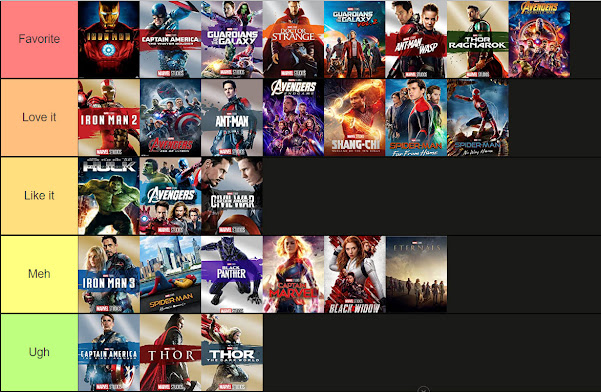
The movies are tiered based on how much I enjoy watching them and how often I will rewatch. I'll rewatch Favorites endlessly. I regret ever watching Ughs even once. My tiers may differ significantly from others. In particular, I prefer Avengers: Infinity War over Avengers: Endgame. I also list Ant-Man and Ant-Man and the Wasp higher than other fans. However, this is my tier list. You can make your own!
Create your own tier list from this template on Tiermaker: https://tiermaker.com/list/marvel-dc/actual-list-of-mcu-movies-as-of-the-end-of-2021-874581/1858535
Sunday, November 21, 2021
Insurrection is a good movie with a bad rap

STIX is not First Contact II, which seems to miss the mark with fans of First Contact. This has harmed STIX's reputation much more than any actual issues with quality. Taken in isolation as a TNG adventure, STIX is actually very entertaining and more in line with the feel of the TNG TV series than any other TNG movies. While First Contact is an excellent action movie, STIX is a good adventure movie.
Regarding the rest of the TNG movies, I feel that Star Trek XI: Generations is a jumbled mess that is a cross between Search for Spoke and The Motion Picture. Additionally, Generations delves deep into space magic to unsuccessfully tie up massive plot holes. Star Trek X: Nemesis is a movie that seems to shoehorn the TNG characters into a Star Trek: Deep Space 9 (DS9) story. What I mean is that the story of Nemesis is darker, with more pew-pew. It also has multiple unrelated or barely-related subplots that are better suited for a season of TV rather than a 2 hr movie. Additionally, Nemesis seems to be written by writers who forget they could build upon already well-established Romulan lore from both TNG and DS9 for a much more cohesive and succinct story. Nemesis is a bad movie that has a good movie buried somewhere deep within it. For more on this, see the video called The Amazing Star Trek: Nemesis Theory You've Never Heard Of.
tl;dr: Although STIX is often listed lower on many ranked Star Trek movie lists, or it's outright called "bad", I feel this is not deserved. STIX is a good movie that got a bad rap because expectations set by First Contact.
Subscribe to:
Posts (Atom)